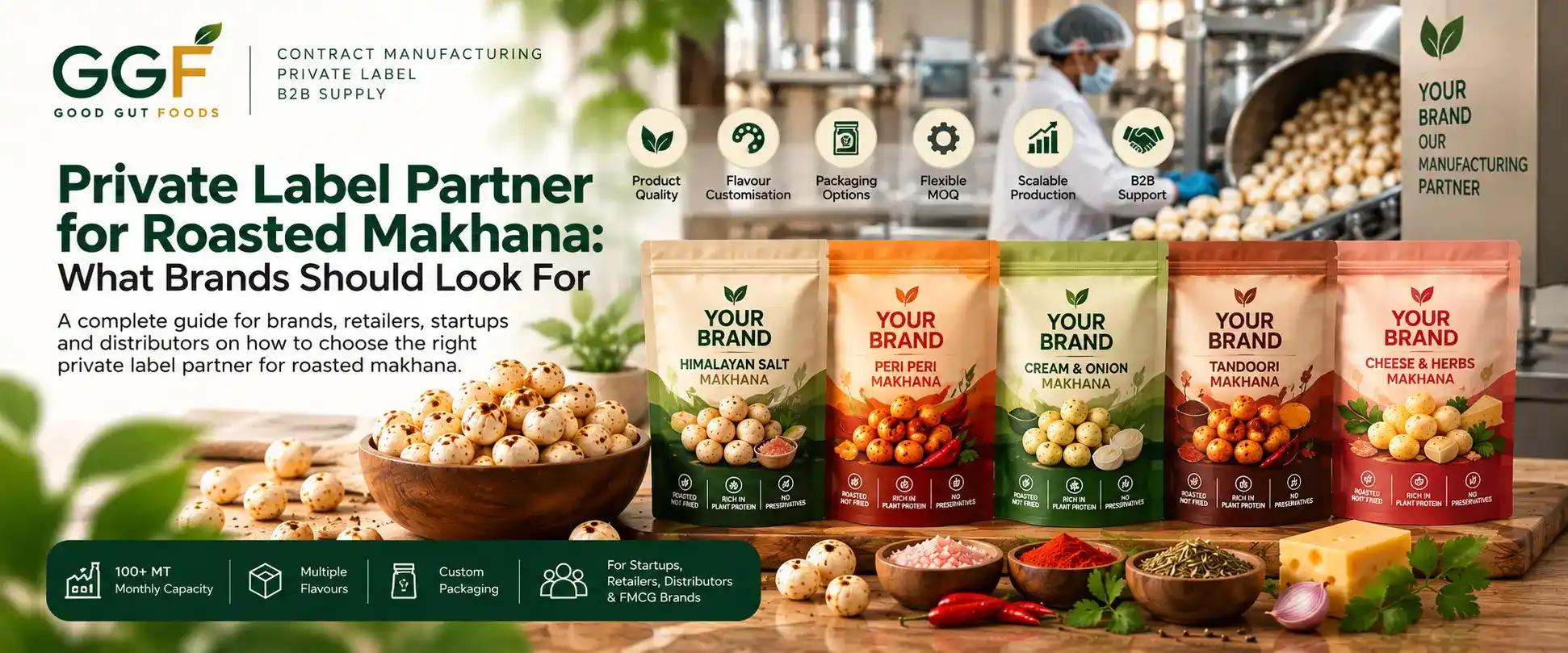
Private Label Partner for Roasted Makhana: What Brands Should Look For
For a food brand, finding a private label partner for roasted makhana is about more than finding a supplier who can provide makhana in bulk.
Your manufacturing partner can influence the final product, flavour, packaging, consistency, production timelines and ability to scale.
This is especially important when the product will be sold under your own brand name.
Whether you are a startup, retailer, distributor, FMCG company or exporter, choosing the right roasted makhana manufacturer can make the process of launching and scaling your product much more organised.
So, what should you look for in a private label roasted makhana partner?
What Does a Private Label Roasted Makhana Partner Do?
A private label manufacturing partner produces roasted makhana for your business so that the finished product can be sold under your brand.
Depending on your requirements, the project can involve:
Roasted makhana production
Flavour and seasoning
Custom product development
Pack-size selection
Private-label packaging
Quality checks
Commercial production
Bulk B2B supply
Repeat-order manufacturing
Instead of setting up your own production facility, you can outsource manufacturing and focus on building your brand and distribution.
1. Start With the Product Specification
Before choosing a manufacturer, define exactly what you want to sell.
"Roasted makhana" can mean different things depending on your product positioning.
You may want:
Plain roasted makhana
Lightly salted makhana
Flavoured roasted makhana
Premium flavoured makhana
Custom-seasoned makhana
You should also define your preferred:
Product size
Texture
Roast profile
Seasoning
Flavour intensity
Pack size
A clear product specification makes it easier to compare manufacturers and obtain an accurate quotation.
2. Check Whether the Manufacturer Can Customise Flavours
For many brands, the opportunity isn't just to sell roasted makhana.
It is to create a distinctive branded snack range.
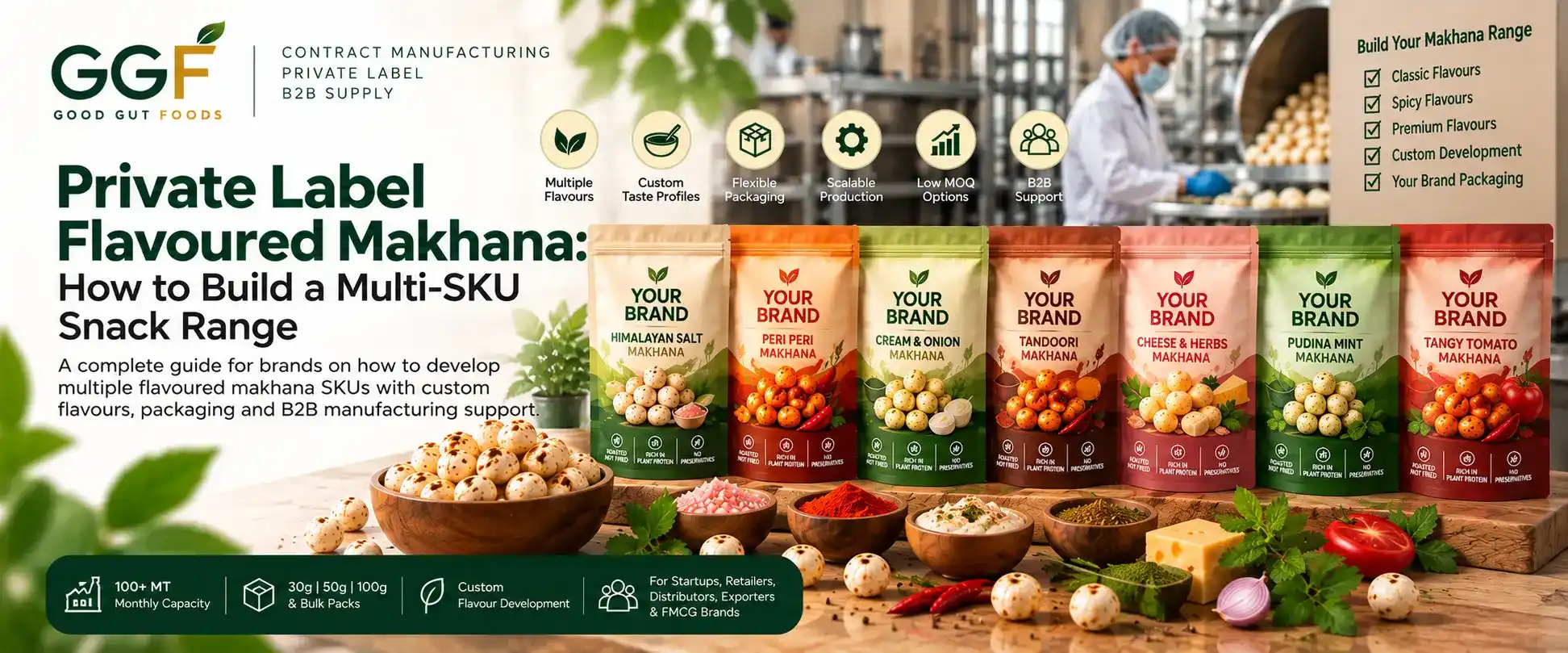
Your brand may want flavours such as:
Peri Peri
Cream & Onion
Tandoori
Himalayan Pink Salt
Pudina Mint
Cheese & Herbs
You may also want to develop a flavour specifically for your target market.
A useful private-label partner should therefore be able to discuss flavour development and seasoning customisation, rather than offering only one standard product.
This becomes particularly important when you plan to build multiple SKUs under the same brand.
3. Ask for Product Samples
Before placing a commercial order, ask to evaluate the actual product.
For roasted makhana, pay attention to:
Crunch
Is the product sufficiently crisp?
Roast Profile
Is the roasting consistent without excessive burning or under-roasting?
Flavour
Does the seasoning match your intended positioning?
Appearance
Does the product look consistent from batch to batch?
Packaging
Does the final pack present the product appropriately for your target market?
A sample evaluation can help you identify product changes before commercial production.
4. Look at Private Label Packaging Capabilities
A private label project isn't complete when the makhana is manufactured.
It needs to reach the customer in your packaging.
Depending on your sales channel, you may require:
Stand-up pouches
Pillow pouches
Jars
Small retail packs
Larger consumer packs
Bulk packs
You may also need different packaging sizes for different channels.
For example:
E-commerce → 50g / 100g packs
Modern retail → retail-ready packs
Corporate gifting → premium packs
B2B distribution → larger case quantities
Discuss your packaging requirements with the manufacturer before finalising your brand artwork.
5. Understand MOQ Per SKU
MOQ is one of the first commercial questions a business should ask.
Don't ask only:
"What is your minimum order?"
Instead ask:
"What is the minimum order per SKU or flavour?"
This distinction matters if you want several flavours.
For example, a brand planning:
Himalayan Salt
Peri Peri
Cream & Onion
Tandoori
needs to understand whether the MOQ applies to the total order or each individual SKU.
Good Gut Foods' current B2B policy provides a standard MOQ of 100 kg per SKU/flavour, with startup flexibility available for smaller multi-flavour requirements.
Understanding this before finalising your product range helps you plan inventory and working capital.
6. Check Whether the Manufacturer Can Scale
A private-label partner should ideally be able to support more than your first order.
Your journey may look like:
First order → Repeat order → Distributor order → Retail expansion → Larger production
If your manufacturer cannot handle increasing volumes, you may eventually need to switch suppliers.
When evaluating a partner, ask about:
Monthly production capacity
Multiple-SKU production
Repeat orders
Bulk orders
Lead time
Packaging capacity
Expansion capability
The objective is to find a supplier that can potentially become a long-term manufacturing partner.
7. Evaluate Quality Control
Your customers will see your brand on the packaging.
They generally won't know who manufactured the product.
Therefore, manufacturing consistency becomes your brand responsibility from the customer's perspective.
Ask your manufacturer about:
Raw material quality
Sorting
Roasting controls
Seasoning consistency
Batch testing
Packaging checks
Shelf-life
Food-safety systems
For a growing FMCG brand, consistency should be considered alongside manufacturing cost.
8. Compare the Complete B2B Cost
A private-label quote can include several components:
Raw material
Processing
Seasoning
Packaging
Printing
Production
Logistics
Instead of comparing manufacturers only on price per kg, compare the complete quotation based on the same specifications.
For example:
100g roasted makhana + Peri Peri flavour + custom pouch + required quantity + delivery location
This makes supplier comparison much more meaningful.
9. Ask About Lead Time
For retail and e-commerce brands, manufacturing delays can create inventory problems.
Before confirming an order, clarify:
Sample development timeline
Packaging development timeline
Production lead time
Dispatch timeline
Repeat-order timeline
Good Gut Foods generally works with a 10–15 day lead time, subject to product, packaging and order requirements.
For a new product launch, it's useful to discuss the timeline before committing to a marketing or retail launch date.
10. Check Whether They Support B2B Documentation
If you're buying for your own brand, you may require documentation for your business and sales channels.
Depending on your market and project, this can include:
GST documentation
FSSAI details
Product specifications
Batch information
Test reports
Certificate of Analysis
Export-related documentation
If you're planning to export, discuss destination-market requirements with the manufacturer before production.
11. Choose a Partner That Understands Brands
There is an important difference between:
A bulk raw-material supplier
and
A private-label manufacturing partner.
A bulk supplier may primarily focus on supplying a commodity.
A private-label partner needs to understand:
Product positioning
Flavours
Packaging
Brand requirements
SKU development
Production planning
Repeat orders
If your objective is to build a consumer brand, the second type of relationship can be more relevant to your requirements.
Who Needs a Private Label Roasted Makhana Partner?
Private label roasted makhana can be relevant for several types of businesses.
Food Startups
Startups can launch a branded snack product without setting up their own manufacturing facility.
Existing Snack Brands
Established brands can add makhana to their portfolio.
Retailers
Retailers can develop an own-brand snack range.
Distributors
Distributors can develop products for specific customer segments or markets.
Exporters
Exporters can source Indian-made makhana for their international brands, subject to applicable market requirements.
Corporate Gifting Businesses
Roasted and flavoured makhana can be included in premium healthy snack boxes.
From Roasted Makhana to a Complete Snack Portfolio
One advantage of working with a manufacturer that produces multiple snack categories is that you don't necessarily have to build your entire portfolio around one product.
Once your makhana range is established, you can explore complementary products such as:
Flavoured Chana
Trail Mix
Seed Mix
Ragi Chips
Corn Chips
Beetroot Chips
Date Bites
Vegetarian Protein Bites
This can allow a brand to gradually move from one private-label SKU to a broader snack portfolio.
Why Good Gut Foods for Private Label Makhana?
Good Gut Foods works with businesses looking for B2B, private-label and contract manufacturing solutions across snack categories.
For makhana, the business can support requirements around:
Roasted and flavoured makhana
Custom flavour profiles
Private-label packaging
Multiple SKUs
B2B bulk supply
Repeat manufacturing
Domestic and export-oriented requirements
The wider Good Gut Foods portfolio also allows businesses to explore multiple snack categories from the same manufacturing partner.
Looking for a Private Label Partner for Roasted Makhana?
If you already have a snack brand—or are planning to launch one—Good Gut Foods can help you explore the manufacturing requirements for roasted and flavoured makhana under your own brand.
Share your:
Flavour + Pack Size + Packaging + Quantity + Delivery Location
and discuss your B2B manufacturing requirement with the team.
Build Your Own Roasted Makhana Brand
Looking for a private label partner for roasted or flavoured makhana? Talk to Good Gut Foods about your product and B2B supply requirements.
CTA: Get a Private Label Makhana Quote →
Frequently Asked Questions
What is a private label roasted makhana partner?
It is a manufacturer that produces roasted or flavoured makhana for your business so the finished product can be sold under your own brand.
Can I customise roasted makhana flavours?
Yes. Depending on the manufacturing arrangement, flavours and seasoning levels can be developed or customised according to your product requirements.
What is the MOQ for private label roasted makhana?
Good Gut Foods' current standard MOQ is 100 kg per SKU/flavour, with startup flexibility available for smaller multi-flavour requirements.
Can startups launch private label roasted makhana?
Yes. Private-label manufacturing allows startups to outsource production rather than setting up their own manufacturing facility.
Can I sell multiple flavours under my brand?
Yes. Multiple flavours can be developed as separate SKUs, subject to the agreed MOQ and production requirements.
Can I add other snacks later?
Yes. A brand can explore additional products such as flavoured chana, trail mix, seed mix, ragi chips, corn chips, beetroot chips and other products from the manufacturer's portfolio.
What information should I provide when requesting a quotation?
Provide your product, flavour, pack size, packaging preference, number of SKUs, quantity, brand requirements and delivery location. This allows the manufacturer to prepare a more relevant B2B quotation.