Private Label Makhana for Startups: From Product Selection to First Order
Starting a food brand can involve a long list of decisions: product development, manufacturing, packaging, branding, inventory and distribution.
For a startup entering the healthy-snacking category, private label makhana manufacturing can provide an alternative to building an in-house production facility.
Instead of investing in machinery and manufacturing infrastructure, a startup can work with an experienced private label makhana manufacturer to develop roasted or flavoured makhana under its own brand.
The key is choosing the right product, packaging, quantity and manufacturing partner before placing the first commercial order.
Why Startups Consider Private Label Makhana
Makhana can be developed into a branded snack product across multiple flavours and pack sizes.
A startup can build a range around:
Roasted makhana
Salted makhana
Flavoured makhana
Premium flavour variants
Small trial packs
Standard retail packs
Larger family packs
Corporate gifting packs
The manufacturing is outsourced, allowing the startup to focus on areas such as:
Brand building
Marketing
Distribution
Retail relationships
E-commerce
Customer acquisition
This is one reason private label manufacturing can be useful for businesses entering the food industry.
Step 1: Decide What Kind of Makhana You Want to Sell
Before contacting a manufacturer, define your product concept.
Do you want:
Plain roasted makhana?
Salted makhana?
Flavoured makhana?
Premium flavoured makhana?
Your decision should be based on your target customer and sales channel.
For example, an online-first brand may want multiple flavour options, while a retailer may initially want a smaller selection of high-volume SKUs.
A clear product brief makes it easier for the manufacturer to recommend suitable production and packaging options.
Step 2: Start With a Focused SKU Range
A common mistake for a new food brand is trying to launch too many products at once.
If you are developing a new private-label makhana brand, you may start with a focused range such as:
1–2 core flavours
1 premium flavour
1–2 pack sizes
This allows you to establish your initial product range before expanding into additional flavours.
As demand develops, additional SKUs can be added based on customer response and distribution requirements.
Step 3: Choose Your Flavour Strategy
Flavour is one of the most important product decisions for flavoured makhana.
A manufacturer may offer existing flavour profiles as well as custom flavour development.
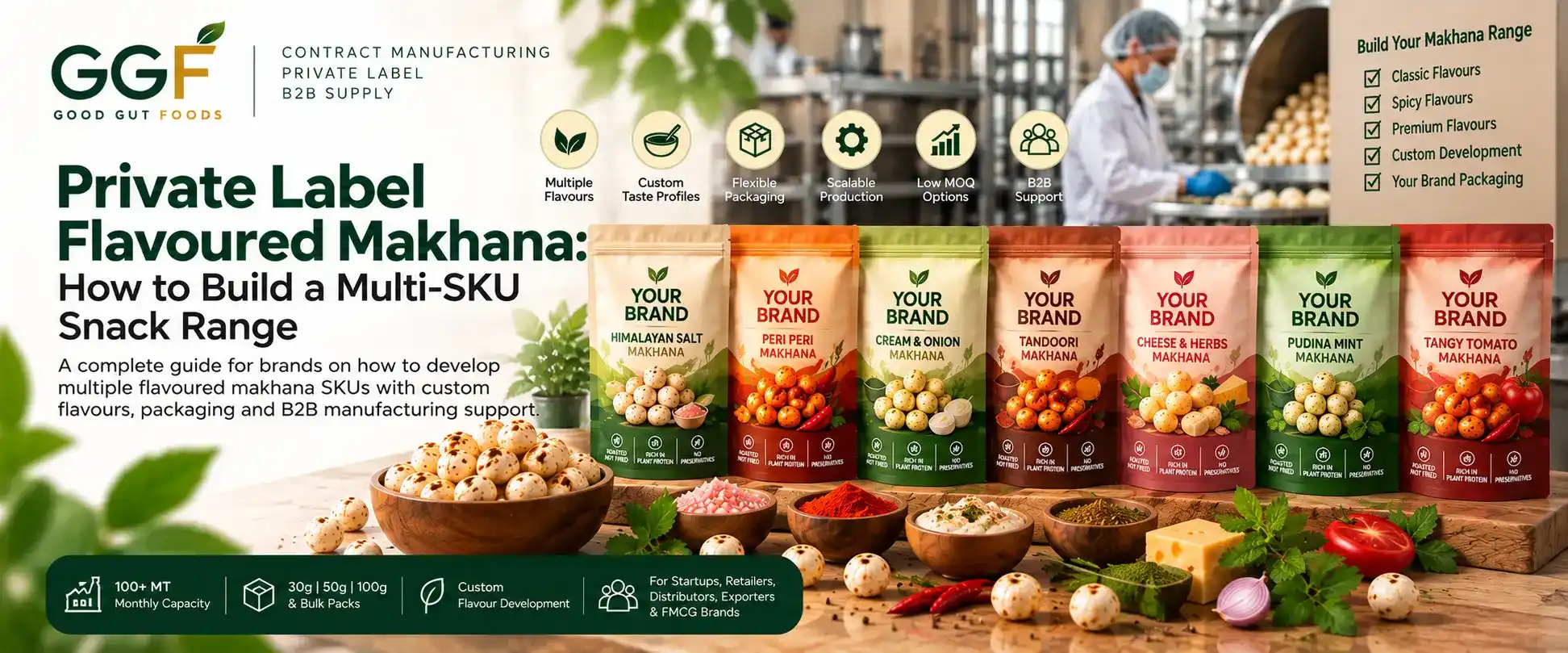
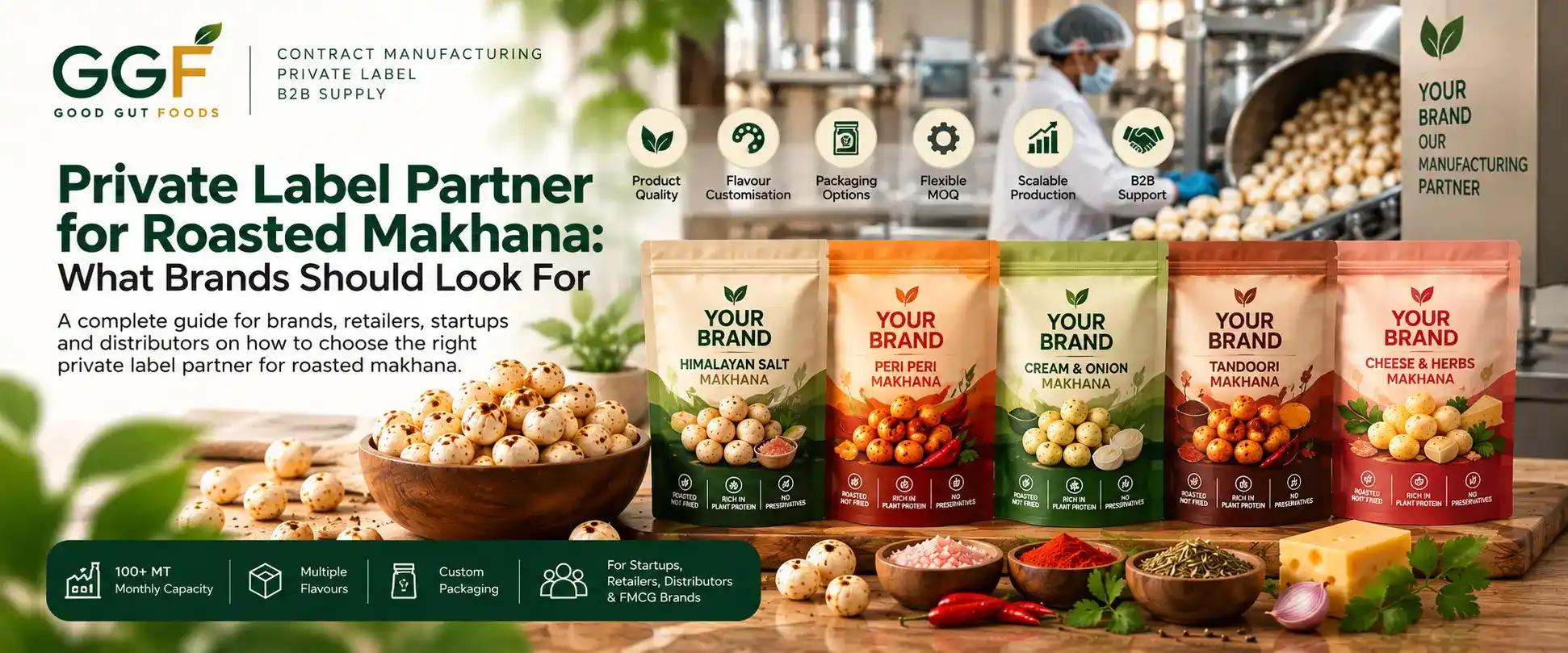
Good Gut Foods offers flavoured makhana in profiles including:
Peri Peri
Cheese & Herbs
Cream & Onion
Himalayan Pink Salt
Tandoori
Tangy Tomato
Pudina Mint
The company also states that seasoning levels and flavour profiles can be customised according to brand specifications.
For a startup, this provides two possible approaches:
Existing flavour profile → faster product development
Custom flavour profile → greater product differentiation
The right option depends on your brand positioning and launch requirements.
Step 4: Select Your Pack Size
Your pack size should match your intended sales channel.
Possible formats can include:
Small trial packs
Standard retail packs
Larger consumer packs
Bulk packs
For private-label projects, Good Gut Foods states that standard pouch dielines are available for 30g, 50g, 100g and bulk pillow pouches.
Before finalising your packaging, consider:
Selling price
Target customer
Retail shelf space
E-commerce shipping
Product positioning
Expected consumption occasion
Step 5: Decide on Your Packaging
Your packaging is the first physical interaction many customers will have with your brand.
For a private-label makhana product, packaging may involve:
Brand identity
Product name
Flavour
Product photography
Nutrition information
Ingredients
Required declarations
Barcode
Manufacturer information
Customer-care information
Good Gut Foods offers customised retail packaging formats, sizes and private-label branding options for domestic and export requirements.
For startups, it is useful to clarify packaging requirements with the manufacturer before finalising artwork.
Step 6: Understand Your MOQ
MOQ is particularly important for startups because inventory ties up working capital.
Before placing an order, ask your manufacturer:
What is the MOQ per SKU?
Is MOQ calculated per flavour?
Is there a different MOQ for different pack sizes?
What is the MOQ for printed packaging?
What quantity is required for repeat orders?
Good Gut Foods states that it offers flexible startup MOQ structures, with product specifications and packaging requirements agreed before mass production.
Understanding MOQ before designing packaging and planning inventory can prevent unnecessary costs.
Step 7: Get Product Samples Before Your First Commercial Order
A startup should not select a product based only on photographs or a description.
Request samples and evaluate:
Taste
Crunch
Roast profile
Flavour intensity
Seasoning
Appearance
Pack presentation
Good Gut Foods' private-label process includes a pre-production pilot sample and client approval before full production.
This gives the brand an opportunity to finalise the product before moving into commercial production.
Step 8: Calculate the Complete Product Cost
A startup should understand the complete B2B economics before placing an order.
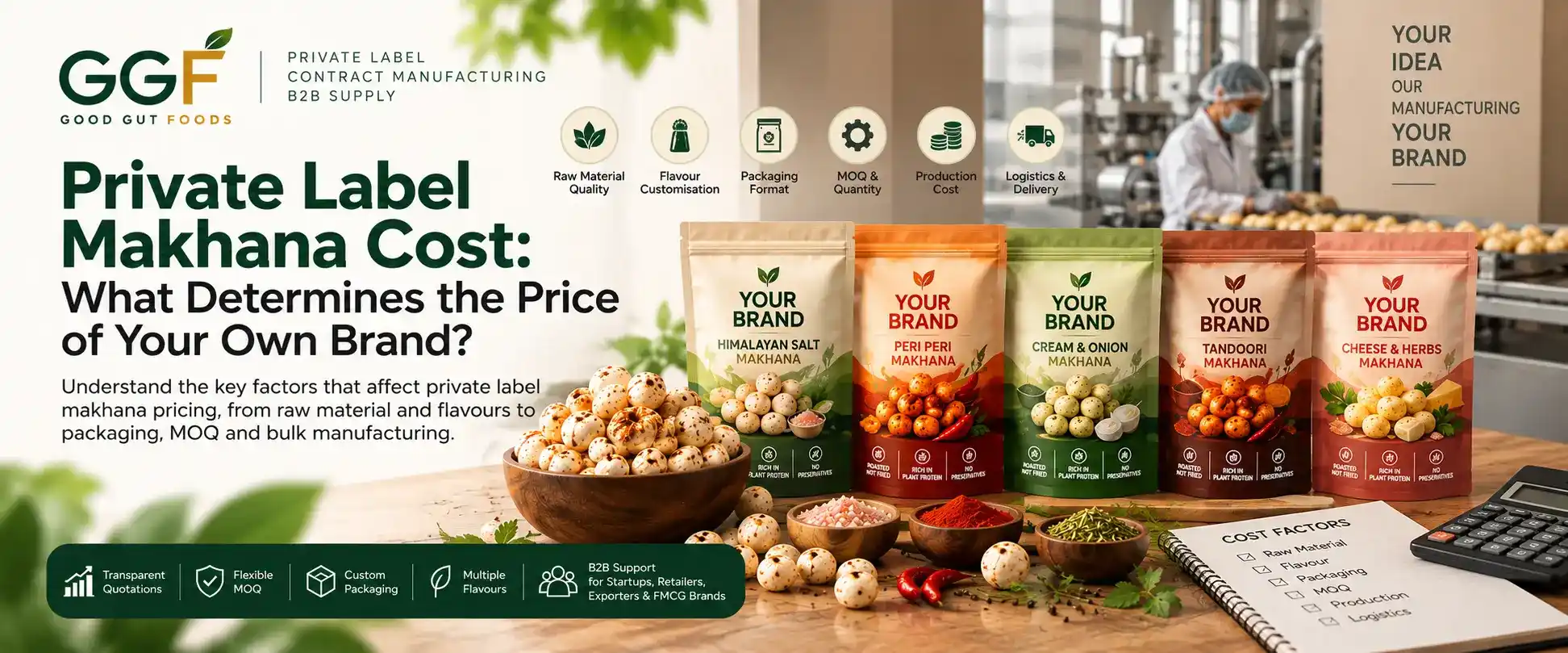
The manufacturing cost can depend on:
Raw material + processing + flavour + packaging + quantity + logistics + applicable charges
Don't ask only:
"What is the price of makhana per kg?"
Instead, give the manufacturer a complete requirement.
For example:
Product: Flavoured Makhana
Flavour: Peri Peri
Pack: 100g
Packaging: Custom pouch
Quantity: Required commercial quantity
Brand: Own brand
Market: India
Delivery: Your warehouse/location
This allows the manufacturer to provide a quotation based on the actual project.
Step 9: Choose a Manufacturer That Can Scale
Your first order may be small, but your manufacturing partner should ideally be capable of handling larger volumes later.
Ask about:
Production capacity
Multiple-SKU production
Repeat orders
Bulk B2B supply
Lead times
Packaging capacity
Export support
Good Gut Foods states that its manufacturing operations have 100+ metric tons of monthly production capacity, along with flexible MOQ structures and export-ready logistics.
For a startup planning long-term growth, scalability should be considered before choosing the first supplier.
Step 10: Understand the Private Label Process
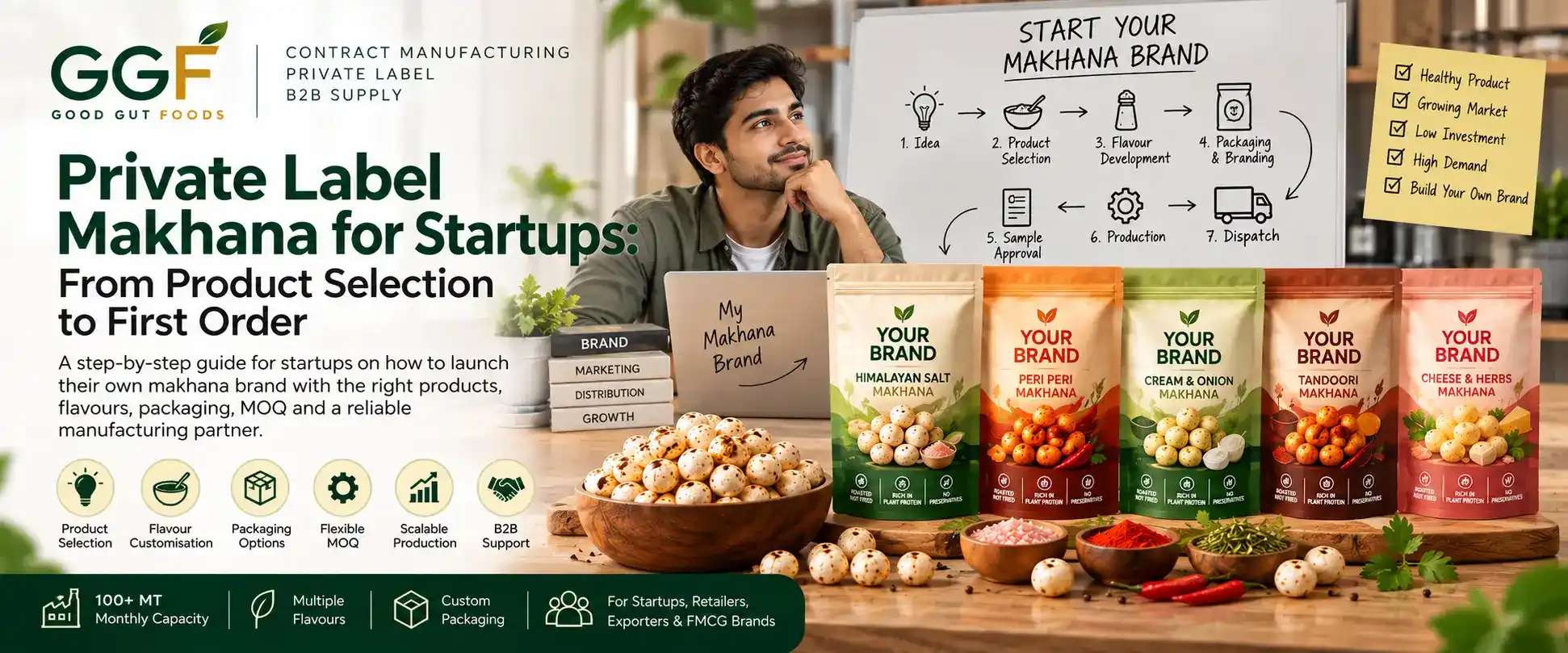
A typical startup journey can look like:
Brand Idea
↓
Product Selection
↓
Flavour Selection
↓
Sample Development
↓
Product Approval
↓
Packaging Artwork
↓
Commercial Quotation
↓
Order Confirmation
↓
Production
↓
Quality Checks
↓
Packaging
↓
Dispatch
The exact workflow can differ by manufacturer and project, but having a defined process helps avoid confusion between the brand and manufacturer.
How Much Should a Startup Order?
There is no single quantity that works for every startup.
Your first order should be based on:
Expected sales
Distribution reach
Shelf life
Working capital
Number of SKUs
Marketing plan
Storage capacity
Reorder timeline
Ordering too much can tie up capital in inventory.
Ordering too little may make production and packaging economics less efficient.
The objective is to find a practical starting quantity that allows you to test the market while keeping your supply chain manageable.
What Should Startups Ask a Private Label Makhana Manufacturer?
Before choosing a partner, ask:
Do you manufacture roasted and flavoured makhana?
Can I create my own flavour?
Can you manufacture under my brand?
What is the MOQ?
What packaging options are available?
Can I choose different pack sizes?
Can I approve samples before production?
What is the production lead time?
Can you handle repeat orders?
What is your production capacity?
Do you support B2B bulk supply?
Can you support export requirements?
What are the payment terms?
What information do you need for a quotation?
Getting these answers before placing your first order can make the launch process significantly clearer.
Private Label Makhana for Startups With Good Gut Foods
Good Gut Foods works with businesses looking for private label, OEM/ODM and contract manufacturing solutions for snack products.
Its flavoured makhana offering includes multiple flavour profiles, custom flavour development, private-label packaging and B2B supply capabilities.
The broader product portfolio also includes Flavoured Chana, Trail Mix, Seed Mix, Corn Chips, Ragi Chips, Protein Bites, Date Bites, Beetroot Chips and Okra Chips. This gives startups the option to develop a broader private-label snack portfolio as their brand grows.
Ready to Launch Your Own Makhana Brand?
You don't need to start by building a manufacturing facility.
The first step is to define your product requirements clearly:
Flavour + Pack Size + Packaging + Quantity + Brand + Market
Once these are defined, a private-label manufacturer can help you evaluate the manufacturing requirements and commercial feasibility.
Start Your Private Label Makhana Project
Looking for a private label makhana manufacturer for your startup? Share your product and quantity requirements with Good Gut Foods and discuss your B2B manufacturing options.
CTA: Request a Private Label Makhana Quote →
Frequently Asked Questions
Can a startup launch its own makhana brand through private label manufacturing?
Yes. A startup can outsource production to a private-label manufacturer instead of establishing its own manufacturing facility.
What is the MOQ for private label makhana?
MOQ depends on the product, flavour, packaging and manufacturing requirements. Good Gut Foods states that it offers flexible startup MOQ structures.
Can startups customise makhana flavours?
Yes. Good Gut Foods offers bespoke flavour profiling and customisable seasoning levels for its flavoured makhana.
Can I sell the makhana under my own brand?
Yes. Private-label manufacturing is specifically designed for products manufactured by one company and sold under another company's brand.
Can I start with multiple flavours?
Multiple flavours can be discussed with the manufacturer based on MOQ, product specifications and production requirements.
Can Good Gut Foods manufacture other snacks for my brand?
Yes. Good Gut Foods has a wider B2B snack portfolio including flavoured chana, trail mix, seed mix, corn chips, ragi chips, protein bites, date bites and beetroot chips.
Can a startup eventually scale its orders?
Yes, provided the manufacturing partner has sufficient production capacity and can support repeat and larger-volume orders. Good Gut Foods states that its manufacturing operations have 100+ metric tons of monthly production capacity.