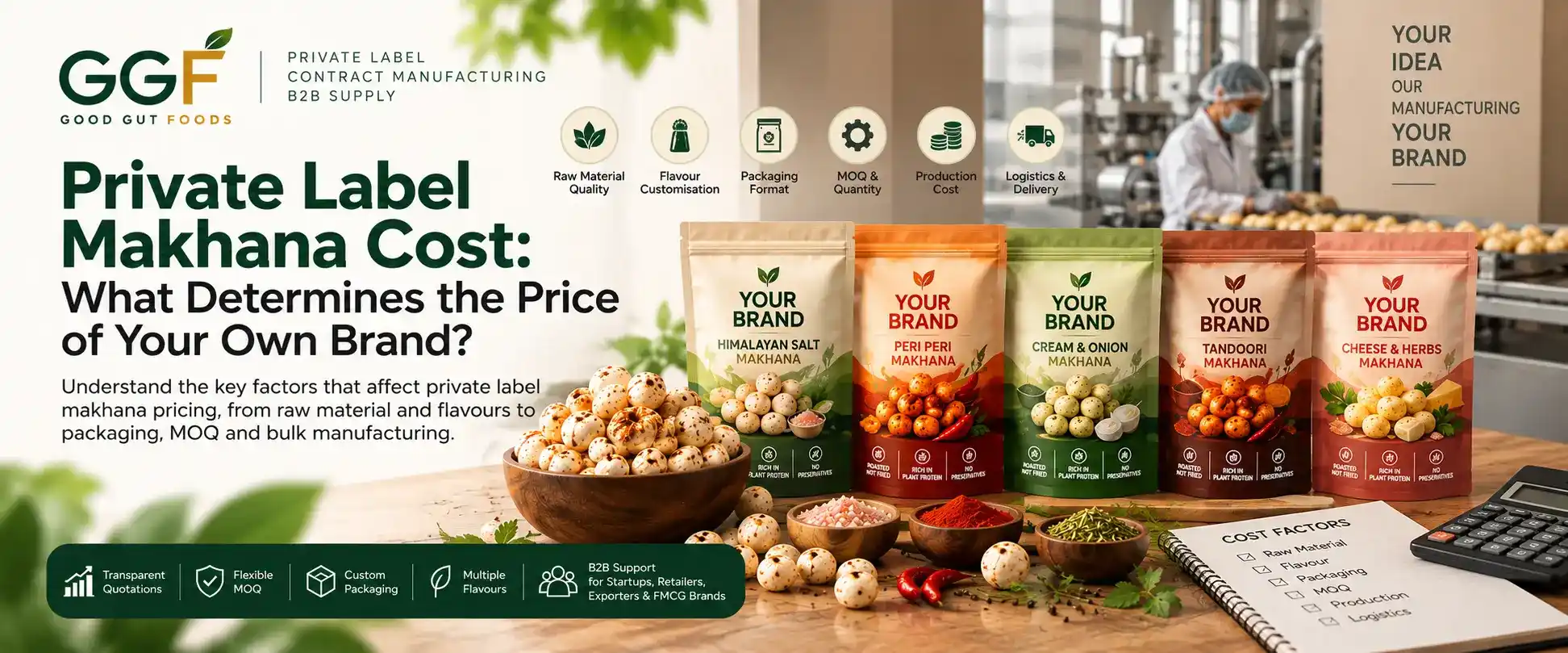
Private Label Makhana Cost: What Determines the Price of Your Own Brand?
If you are planning to launch your own makhana brand, one of the first questions you will probably ask a manufacturer is:
"What is the cost of private label makhana?"
There isn't one universal price for private label makhana because the final B2B quotation depends on several variables.
The cost can change based on the type of makhana, raw material specification, flavour, seasoning, pack size, packaging format, order quantity, customisation and logistics requirements.
Understanding these factors before requesting a quotation can help you prepare a more accurate product brief and compare manufacturing proposals more effectively.
What Is Included in Private Label Makhana Pricing?
A private label quotation can involve several different components.
Depending on your project, the overall cost may include:
Makhana raw material
Roasting and processing
Seasoning
Custom flavour development
Packaging material
Printing and branding
Filling and packing
Quality testing
Product development
Logistics
Applicable taxes and other commercial charges
Therefore, simply comparing a manufacturer's price per kilogram may not provide a complete picture.
A better approach is to request a quotation based on your exact SKU requirements.
1. Makhana Raw Material Quality
The underlying makhana specification is one of the major factors affecting product economics.
Different raw material specifications can influence:
Size
Appearance
Texture
Yield
Sorting requirements
Final product positioning
A premium retail product may require different raw material specifications than a value-oriented bulk product.
When requesting a quotation, clearly communicate the product specification you want rather than asking only for a generic "makhana price."
2. Roasted vs Flavoured Makhana
The manufacturing requirements can differ depending on whether you want:
Roasted Makhana
or
Roasted + Seasoned/Flavoured Makhana
Flavoured products can involve additional requirements for seasoning, flavour development, application and quality control.
Good Gut Foods offers roasted and flavoured makhana with multiple flavour profiles and bespoke seasoning options for private-label requirements.
Therefore, your B2B quotation should specify whether you require a plain roasted product or a customised flavoured SKU.
3. Custom Flavour Development
A standard flavour and a completely customised flavour may have different development requirements.
For example, a brand may choose an existing flavour profile such as:
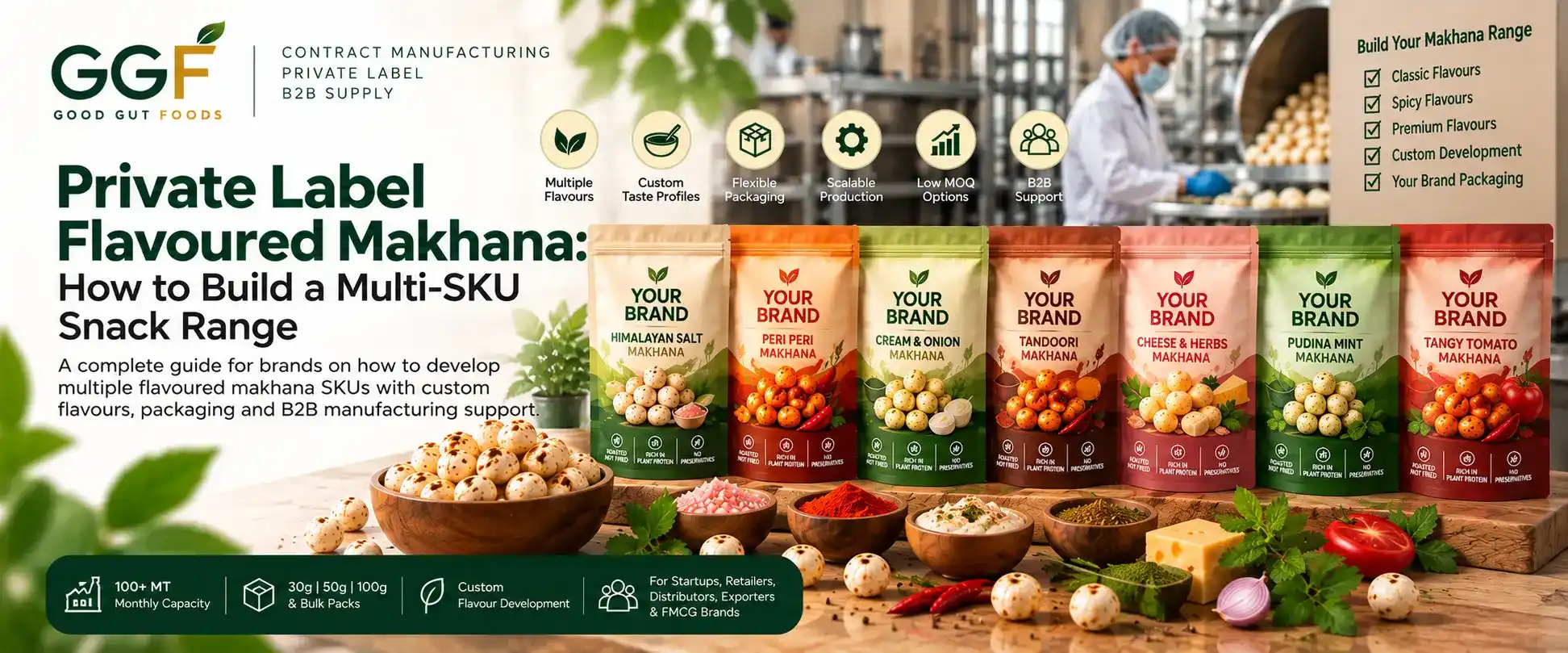
Peri Peri
Cream & Onion
Tandoori
Himalayan Pink Salt
Pudina Mint
Alternatively, it may request a specific flavour profile developed for its brand.
Good Gut Foods states that seasoning levels and flavour profiles for its flavoured makhana can be customised according to brand specifications.
If your project requires new flavour development, mention this at the quotation stage.
4. Pack Size
The same product can have different economics depending on the pack size.
For example:
Small trial packs
Standard retail packs
Family packs
Multipacks
Bulk packs
The packaging material, filling process and production planning can vary according to the pack format.
Good Gut Foods provides standard pouch dielines for 30g, 50g, 100g and bulk pillow pouches for private-label projects.
5. Packaging Format
Packaging is another major component of a private-label quotation.
Depending on the project, a business may choose:
Stand-up pouch
Pillow pouch
PET jar
Composite packaging
Other customised retail formats
The final cost can vary according to the packaging material, dimensions, printing requirements and quantity.
Good Gut Foods offers customised retail packaging formats, sizes and private-label branding for domestic and export requirements.
So when asking for a quote, don't simply say:
"Give me the price of private label makhana."
Instead, provide:
Flavour + pack size + packaging format + quantity + destination
This gives the manufacturer a much clearer basis for quotation.
6. Minimum Order Quantity
MOQ is another important factor in private-label manufacturing.
A manufacturer may calculate pricing differently for:
Small trial production
versus
Large commercial production
Higher volumes can change production planning, packaging procurement and overall manufacturing economics.
Good Gut Foods states that it offers flexible startup MOQ structures, with product specifications and packaging requirements confirmed before mass production.
For a new brand, ask about:
MOQ per SKU
MOQ per flavour
MOQ per packaging format
Sample quantity
Repeat-order quantity
7. Number of SKUs
Suppose you want to launch:
1 SKU
versus
5 different flavours
The production and packaging requirements can be very different.
A multi-SKU launch may require separate:
Flavour specifications
Packaging artwork
Printed packaging
Production batches
Quality checks
Inventory planning
If you're launching several flavours, mention the complete SKU plan when requesting a quotation.
8. Custom Packaging Artwork
Private label means the product carries your brand, so packaging artwork becomes part of the process.
Good Gut Foods requires private-label clients to provide print-ready artwork and provides standard pouch dielines for specified formats.
Before production, your manufacturer may need:
Logo
Product name
Nutritional information
Ingredients
Legal declarations
Barcode
Manufacturer details
Customer/brand information
Artwork in the required format
The exact labelling requirements depend on the market in which the product will be sold.
9. Product Sampling and Approval
Before commercial production, brands generally need to approve the final product specification.
This can include:
Flavour
Texture
Roast profile
Seasoning
Packaging
Product appearance
Good Gut Foods' private-label policy states that pre-production pilot samples are produced for texture, roast profile and flavour matching, with client sign-off required before full production.
This stage should be considered part of the overall product-development process.
10. Quality and Testing Requirements
Quality requirements can also affect the overall project cost.
Depending on the product and market, businesses may require:
Product testing
Microbiological testing
Moisture testing
Shelf-life evaluation
Certificate of Analysis
Export documentation
Good Gut Foods' B2B terms state that batches undergo laboratory testing for moisture, microbiology and shelf-life stability, with third-party inspection available on request.
For export projects, additional documentation or destination-market requirements may apply.
11. Logistics and Delivery Location
The final B2B cost isn't always the factory-gate product price.
Your total procurement cost can also depend on:
Manufacturing + Packaging + Logistics + Applicable Taxes/Charges
A shipment going to a nearby warehouse may have different logistics costs from a shipment going to another Indian state or an international destination.
Therefore, always provide the delivery location when requesting a quotation.
How to Get an Accurate Private Label Makhana Quote
If you want a manufacturer to provide a useful quotation, send a clear product brief.
For example:
Product: Flavoured Makhana
Flavour: Peri Peri
Pack Size: 100g
Packaging: Stand-up pouch
Quantity: 1,000 kg
Brand: Your own brand
Market: India
Customisation: Existing flavour / custom flavour
Delivery Location: Jaipur
This gives the manufacturer enough information to prepare a much more relevant B2B proposal.
Don't Compare Private Label Manufacturers Only on Price
When comparing two manufacturers, avoid looking at only one number.
Instead, compare:
FactorWhat to CheckProductRaw material and specificationsFlavourStandard or customPackagingFormat, size and printingMOQQuantity per SKU/flavourQualityTesting and controlsSamplingPre-production approvalCapacityAbility to scaleLead TimeProduction and dispatch timelineLogisticsDelivery cost and locationSupportB2B and private-label assistance
This provides a more complete picture of the manufacturing proposal.
Private Label Makhana With Good Gut Foods
Good Gut Foods works with businesses looking for private label, OEM/ODM and contract manufacturing solutions for snack products.
Its flavoured makhana offering includes multiple flavour profiles, bespoke flavour development, customised packaging and B2B supply capabilities. The company states that its makhana operations have 100+ metric tons of monthly production capacity, flexible MOQ structures and export-ready logistics.
For businesses looking beyond makhana, Good Gut Foods also offers products such as Flavoured Chana, Trail Mix, Seed Mix, Corn Chips, Ragi Chips, Protein Bites, Date Bites, Beetroot Chips and Okra Chips, allowing brands to explore a broader private-label snack portfolio.
Looking for a Private Label Makhana Quote?
If you're planning to launch roasted or flavoured makhana under your own brand, the best way to understand your actual manufacturing cost is to share your exact product requirements.
Tell the Good Gut Foods B2B team:
Desired flavour
Pack size
Packaging format
Number of SKUs
Approximate quantity
Delivery location
Domestic or export requirement
The team can then evaluate the requirement and provide a B2B quotation based on the project specifications.
Request Your Private Label Makhana Quote
Planning your own makhana brand? Discuss your product and packaging requirements with Good Gut Foods.
Request a B2B Quote for Flavoured Makhana
Frequently Asked Questions
How much does private label makhana cost?
There is no single price for every private-label makhana project. Cost depends on raw material specification, flavour, pack size, packaging, MOQ, customisation, testing and logistics.
What affects private label makhana pricing the most?
Common factors include product specification, flavour, packaging, order quantity, number of SKUs and delivery requirements.
Can I get a custom flavour for my makhana brand?
Yes. Good Gut Foods states that its makhana seasoning levels and flavour profiles can be customised according to brand specifications.
Is private label makhana suitable for startups?
Private label manufacturing can allow startups to launch branded products without establishing their own manufacturing facility. Good Gut Foods states that it offers flexible startup MOQ structures.
Can I order different makhana flavours under one brand?
Multiple SKUs can be discussed with the manufacturer based on flavour, quantity, packaging and production requirements.
Can private label makhana be made for export?
Yes, private-label makhana can be developed for export markets, but the applicable destination-country food, packaging, labelling and documentation requirements should be confirmed before production. Good Gut Foods states that it can assist with export documentation, including CoA and phytosanitary certificates where applicable.