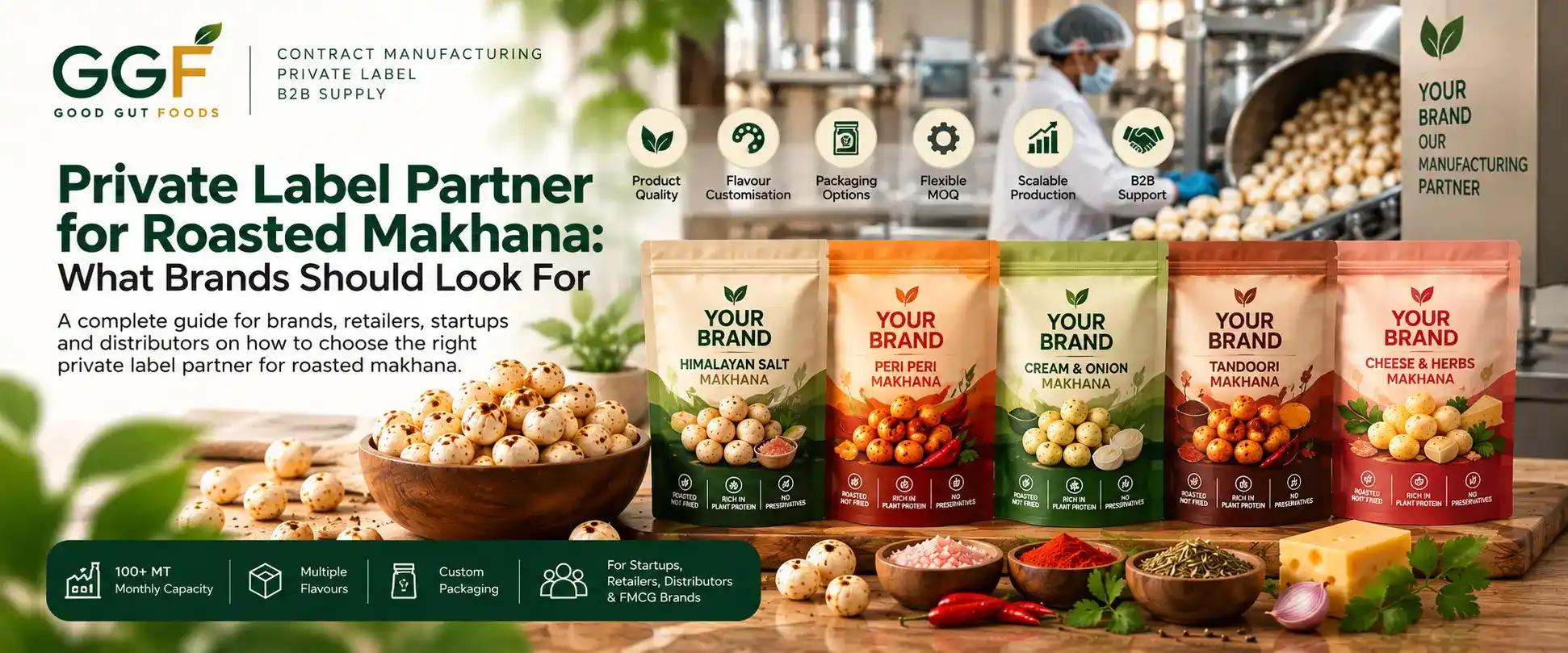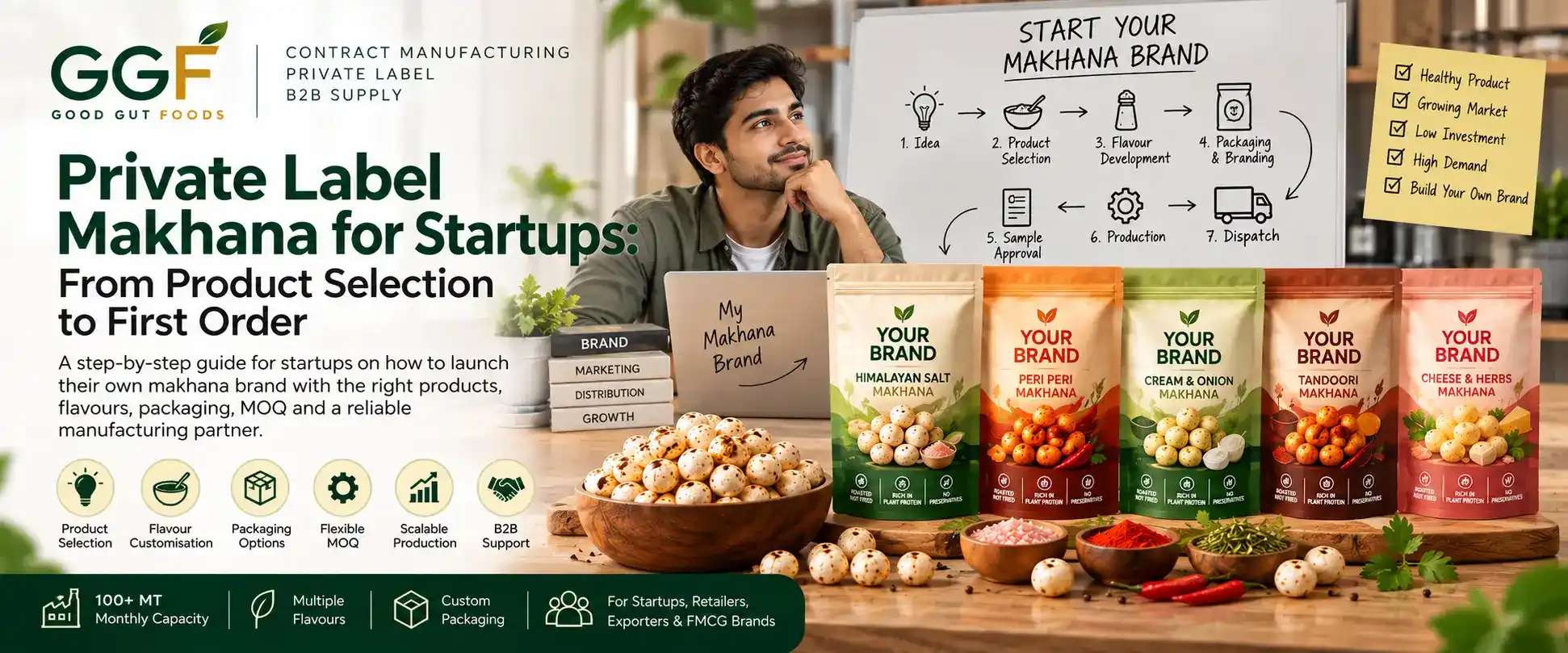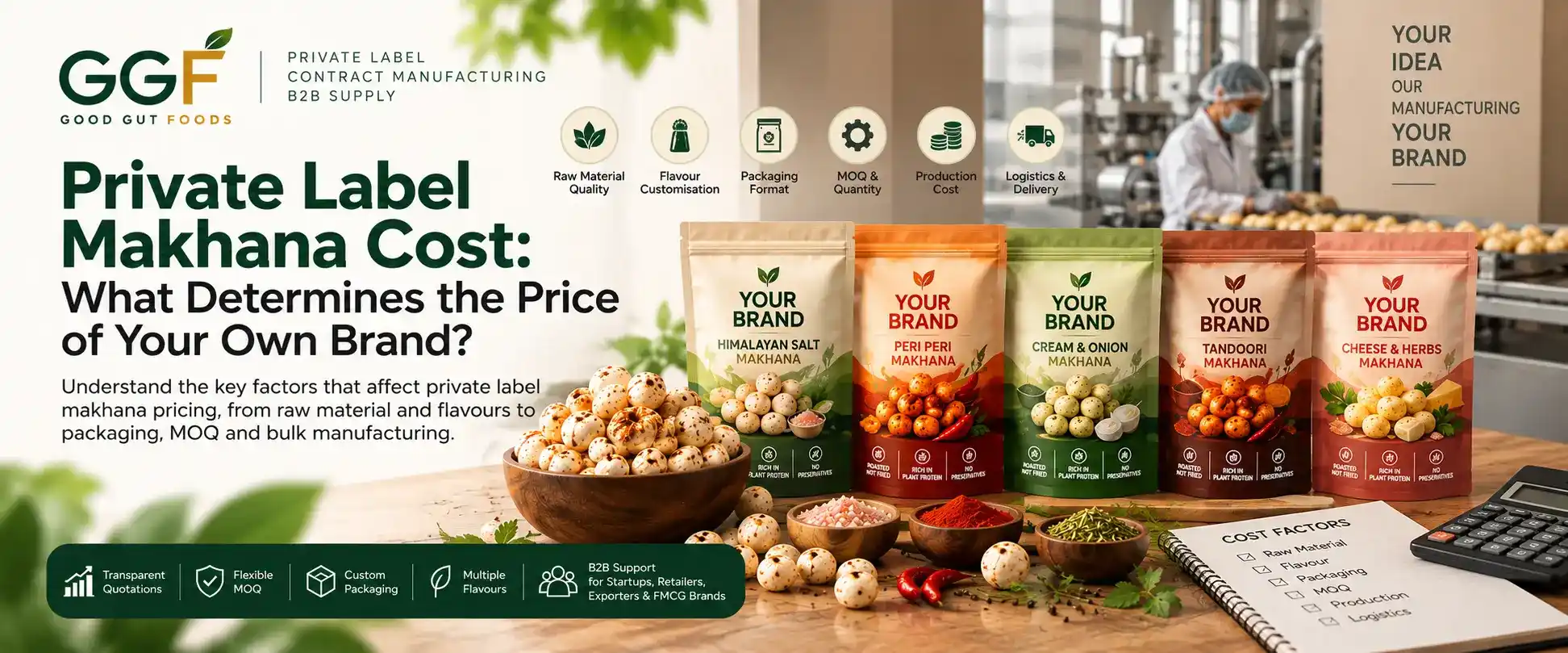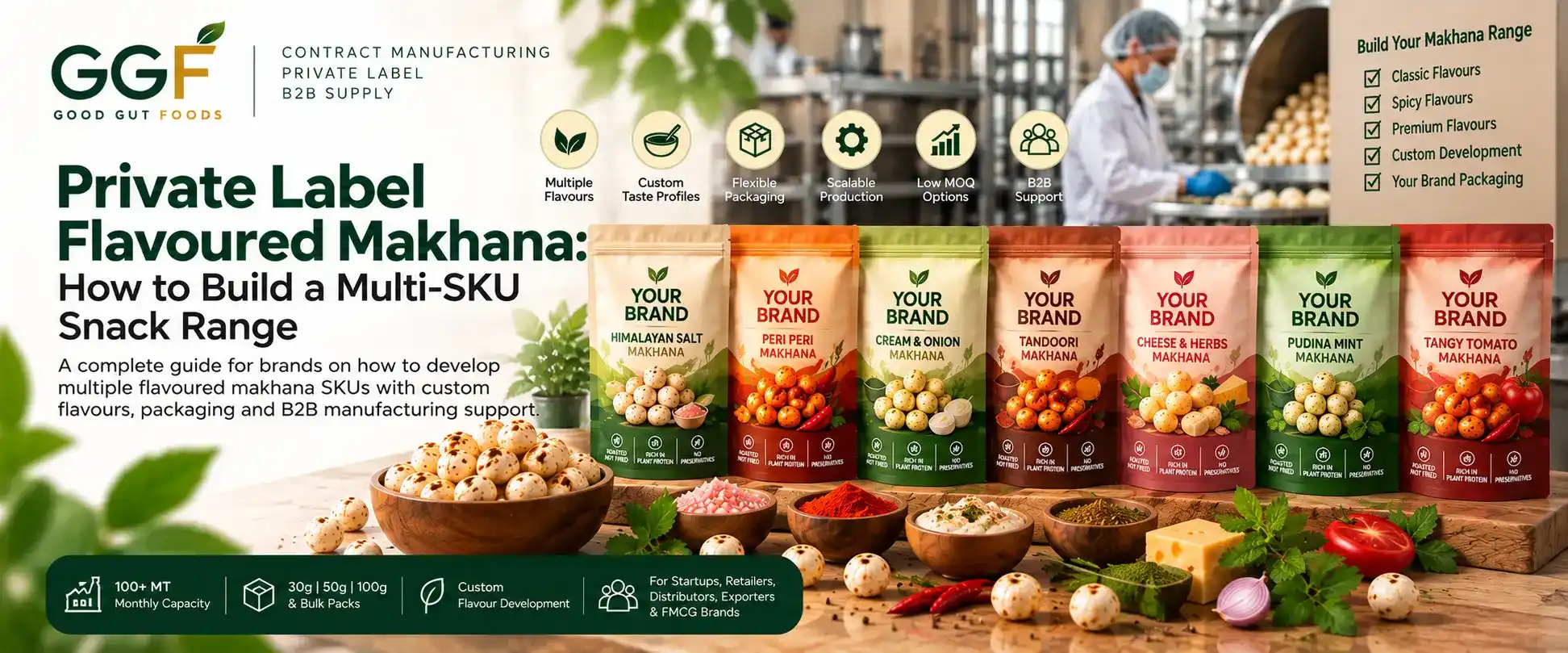
Private Label Flavoured Makhana: How to Build a Multi-SKU Snack Range
Launching one makhana product can be a way for a food brand to enter the healthy snacking category. But for businesses looking to build a larger consumer brand, the opportunity often lies in developing multiple flavoured makhana SKUs under one brand.
Instead of offering only one roasted makhana product, a brand can create a range with different flavour profiles, pack sizes and positioning.
For businesses considering this approach, working with a private label flavoured makhana manufacturer can simplify product development, manufacturing and packaging.
What Is Private Label Flavoured Makhana?
Private label flavoured makhana is a roasted makhana product manufactured by one company and sold under another company's brand.
The brand can define requirements around:
Flavour
Seasoning
Pack size
Packaging
Product positioning
Quantity
Number of SKUs
The manufacturing partner handles the agreed production process.
This allows businesses to develop their own makhana range without investing in a complete manufacturing setup.
Why Build Multiple Makhana SKUs?
A multi-SKU range can give a brand more opportunities to serve different customer preferences.
For example, a brand could develop:
Classic Range
Himalayan Pink Salt
Lightly Salted
Spicy Range
Peri Peri
Tandoori
Creamy / Premium Range
Cream & Onion
Cheese & Herbs
Indian Flavour Range
Pudina Mint
Tangy Tomato
The exact range should depend on the brand's target market, pricing strategy and distribution channels.
Good Gut Foods currently offers multiple flavoured makhana profiles, including Peri Peri, Cheese & Herbs, Cream & Onion, Himalayan Pink Salt, Tandoori, Tangy Tomato and Pudina Mint.
Start With the Right Number of SKUs
More SKUs do not automatically mean a better product range.
For a new brand, launching too many flavours can create:
Higher inventory requirements
More packaging SKUs
More working capital requirements
More production planning
More complex stock management
A focused initial range can be easier to manage.
For example:
3 flavours × 1 pack size
can be a simpler starting point than:
8 flavours × 3 pack sizes
The right number depends on your sales channel and expected demand.
Choose Flavours Based on Your Target Customer
Your flavour strategy should have a clear reason behind it.
Consider who will buy the product.
For mainstream retail
Familiar flavours may be easier for customers to understand.
For premium brands
More differentiated or premium flavour combinations may fit the positioning.
For younger consumers
Brands may explore stronger, spicier or more experimental flavour profiles.
For export markets
Flavours may need to be adapted to local consumer preferences.
This is where a manufacturer with flavour development capabilities can become useful.
Custom Flavour vs Existing Flavour
When developing a private label product, brands generally have two approaches.
Option 1: Existing Flavour Profile
You select a flavour already available from the manufacturer.
Potential advantages:
Faster product development
Easier sampling
Simpler production planning
Established flavour profile
Option 2: Custom Flavour Development
You work with the manufacturer to develop a flavour according to your requirements.
Potential advantages:
Greater differentiation
More control over seasoning
Brand-specific product positioning
Opportunity to create a signature SKU
Good Gut Foods states that seasoning levels and flavour profiles for its flavoured makhana can be customised according to brand specifications.
Don't Forget the Product Texture
Flavour is only one part of the product.
For roasted makhana, brands should also evaluate:
Crunch
Roast level
Size consistency
Seasoning coverage
Mouthfeel
Overall product appearance
A flavour can be excellent, but if the texture does not match your product positioning, the finished SKU may not perform as expected.
This is why product samples and pre-production approval are important before commercial manufacturing.
Select Pack Sizes According to Your Sales Channel
A multi-SKU range doesn't necessarily require multiple pack sizes from day one.
You can initially choose one core pack size and introduce additional formats later.
For example:
Online launch: 50g or 100g
Retail: 50g / 100g
Family consumption: Larger packs
Corporate gifting: Premium smaller packs or curated combinations
Good Gut Foods states that its private-label process supports standard pouch dielines for 30g, 50g, 100g and bulk pillow pouches.
Packaging Should Create a Consistent Brand Family
When you have multiple flavours, the packaging should make them look like they belong to the same brand.
A good multi-SKU system usually maintains:
Same logo placement
Consistent typography
Similar layout
Consistent product naming
Clear flavour differentiation
Similar pack structure
The objective is to make it easy for a customer to recognise:
This is the same brand, but a different flavour.
Good Gut Foods offers customised retail packaging formats, sizes and private-label branding options for B2B requirements.
Plan Your MOQ Across Multiple SKUs
This becomes particularly important when launching a multi-flavour range.
Suppose your brand wants:
Peri Peri
Cream & Onion
Tandoori
Himalayan Pink Salt
You need to understand the MOQ per SKU/flavour, not just the total order quantity.
Good Gut Foods' current standard B2B MOQ is 100 kg per SKU/flavour, with startup flexibility available for smaller multi-flavour requirements.
This allows brands to plan their initial production more realistically.
Calculate the Economics of Each SKU
Every flavour should make commercial sense.
Your B2B product economics can depend on:
Raw material + processing + flavour + packaging + production quantity + logistics
A premium flavour may have different economics from a standard seasoning.
Similarly, a small pack may have different packaging economics from a larger pack.
Before finalising the range, calculate the expected:
Manufacturing cost
Packaging cost
Wholesale price
Retail price
Distributor margin
Marketing cost
Logistics cost
This helps ensure that the product range is commercially viable.
Build a Range That Can Expand
Your first range doesn't have to be your final range.
A brand could start with:
Phase 1
3 core flavours
↓
Phase 2
Add 2 premium flavours
↓
Phase 3
Introduce new pack sizes
↓
Phase 4
Expand into complementary snack categories
This approach allows the brand to develop its portfolio progressively rather than trying to launch everything at once.
Why a Multi-Category Manufacturing Partner Can Help
Once a brand establishes its makhana range, it may want to expand into other healthy snack categories.
Good Gut Foods' broader product portfolio includes:
Flavoured Chana
Trail Mix
Seed Mix
Ragi Chips
Corn Chips
Beetroot Chips
Date Bites
Vegetarian Protein Bites
Okra Chips
This can allow a brand to explore a broader private-label snack portfolio while working with the same B2B manufacturing partner.
What to Ask a Private Label Flavoured Makhana Manufacturer
Before starting production, ask:
Which makhana flavours are currently available?
Can you develop custom flavours?
Can seasoning levels be adjusted?
What is the MOQ per flavour?
What pack sizes are available?
Which packaging formats do you support?
Can I approve samples before production?
What is the production lead time?
Can you manufacture multiple SKUs?
What is the production capacity?
Can you support repeat orders?
Can you supply other snack categories?
Can you support export requirements?
Can you provide a complete B2B quotation?
Private Label Flavoured Makhana With Good Gut Foods
Good Gut Foods works with businesses looking for private label, third-party and contract manufacturing solutions for snack products.
For flavoured makhana, the company supports:
Multiple flavour profiles
Custom flavour development
Seasoning customisation
Private-label packaging
Multiple pack sizes
B2B bulk supply
Scalable production
The flavoured makhana portfolio includes Peri Peri, Cheese & Herbs, Cream & Onion, Himalayan Pink Salt, Tandoori, Tangy Tomato and Pudina Mint, with scope for bespoke flavour profiles.
Build Your Own Private Label Makhana Range
If you are planning to launch a makhana brand, you don't have to start with a large catalogue.
Start by defining:
Target Customer
↓
3–4 Core Flavours
↓
Pack Size
↓
Packaging
↓
MOQ
↓
Production Requirement
↓
B2B Manufacturing Partner
Good Gut Foods can work with businesses to discuss the product, flavour, packaging and quantity requirements for their private-label makhana project.
Looking for a Private Label Flavoured Makhana Manufacturer?
Share your flavour, pack size, quantity and branding requirements with the Good Gut Foods B2B team.
CTA: Discuss Your Private Label Makhana Requirement →
Frequently Asked Questions
Can I create multiple flavoured makhana SKUs under my own brand?
Yes. Multiple flavours can be developed as separate SKUs, subject to the manufacturer's MOQ, production schedule and product specifications.
Can I customise the flavour?
Good Gut Foods states that seasoning levels and flavour profiles can be customised according to brand requirements.
What is the MOQ for flavoured makhana?
Good Gut Foods' standard MOQ is currently 100 kg per SKU/flavour, with startup flexibility for smaller multi-flavour requirements.
Can I choose different pack sizes?
Yes. Packaging and pack-size requirements can be discussed during the product-development stage.
Can startups launch multiple flavours?
Yes. Startups can discuss a multi-flavour launch based on their budget, MOQ, target market and inventory requirements.
Can I add other snacks to my brand later?
Yes. Good Gut Foods also manufactures other snack categories, including flavoured chana, trail mix, seed mix, ragi chips, corn chips, beetroot chips, date bites and vegetarian protein bites.
Can Good Gut Foods manufacture my complete private-label snack range?
The feasibility depends on the specific products, quantities and packaging requirements. Businesses can share their product requirements with the B2B team for evaluation and quotation.