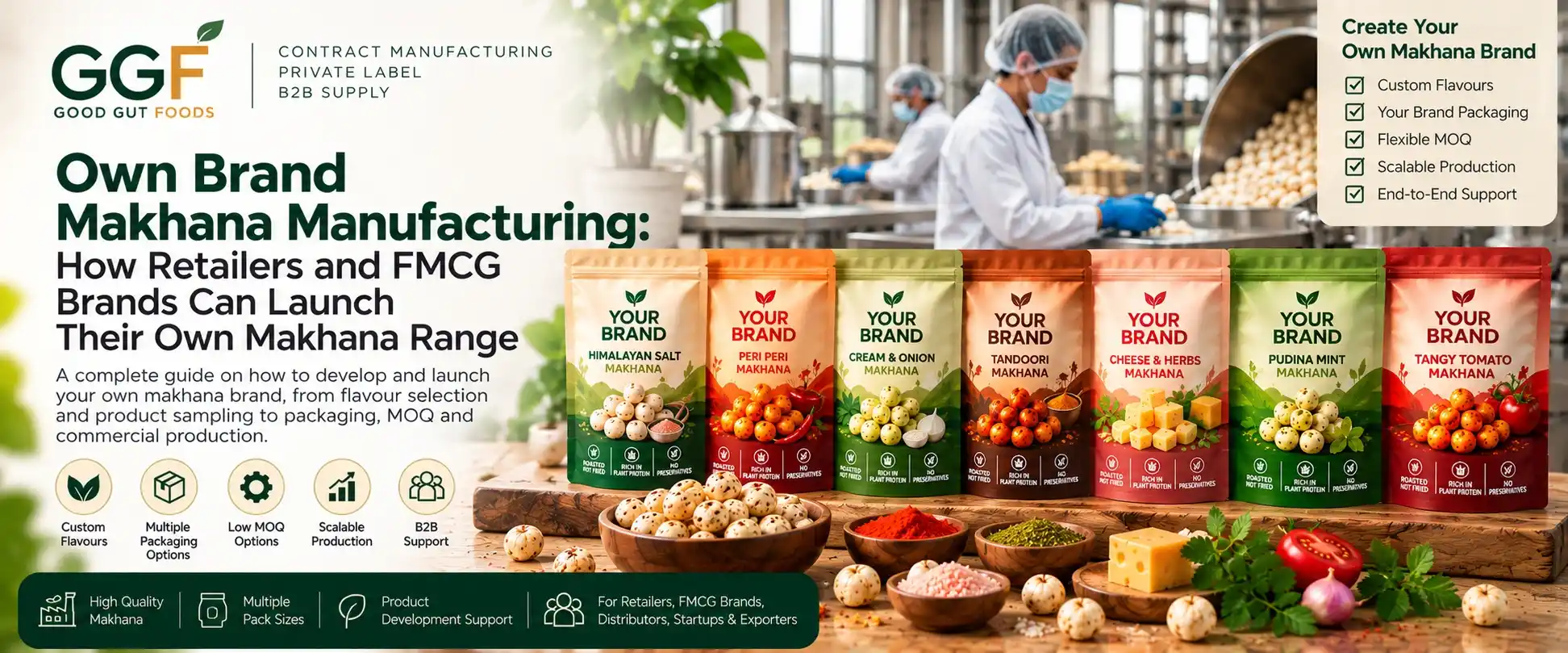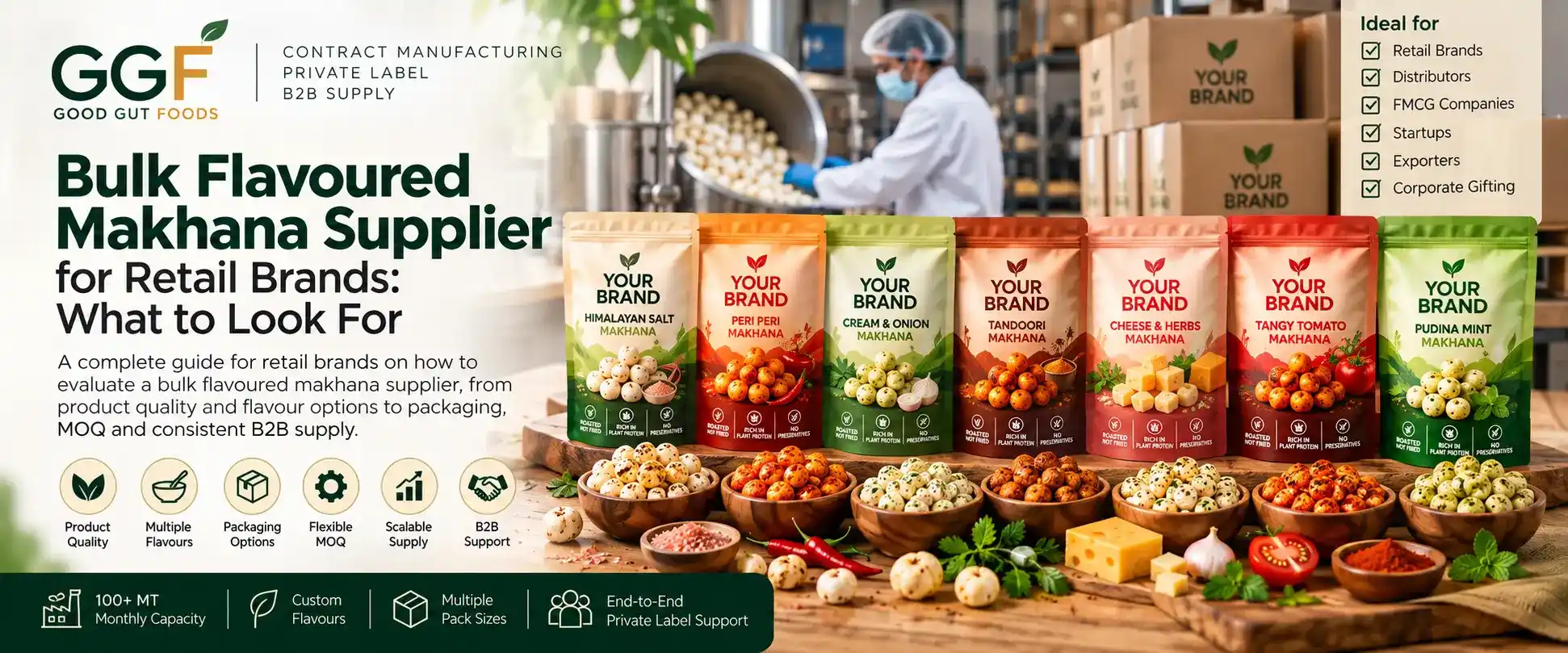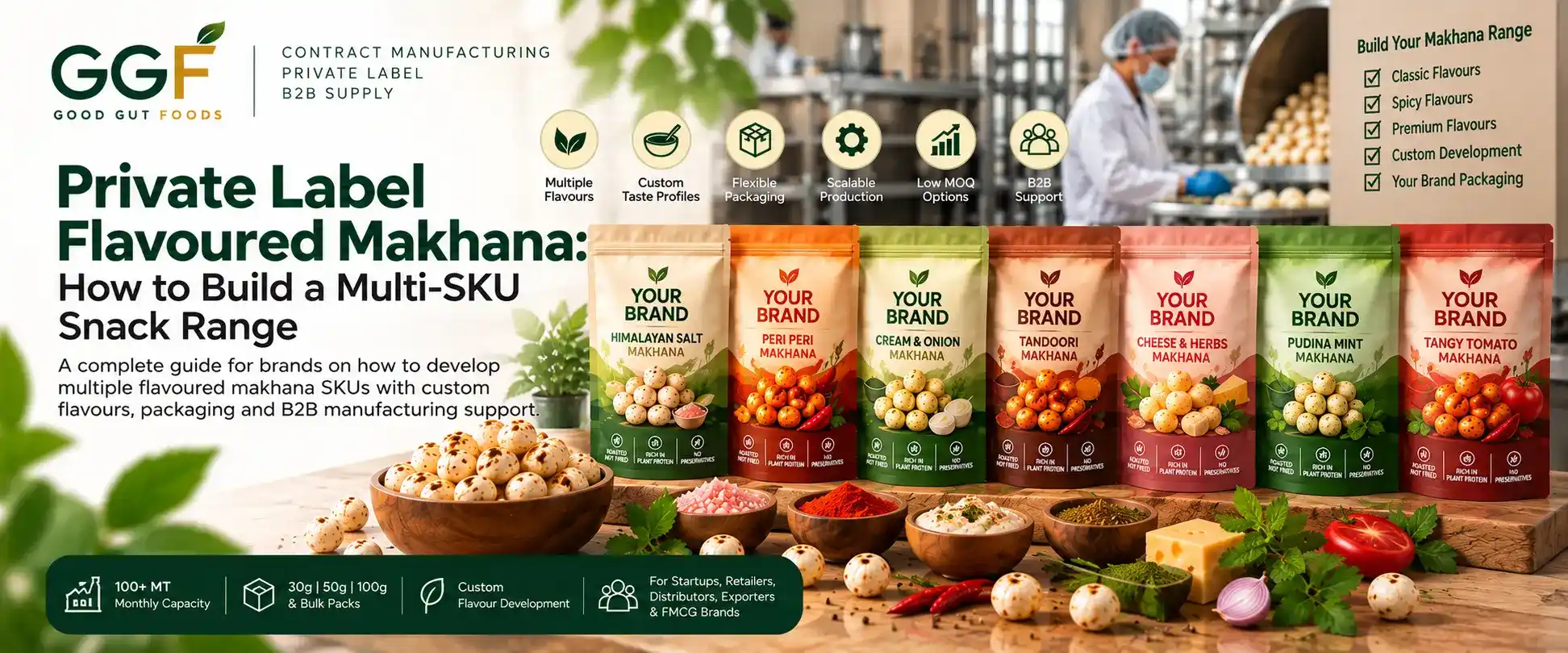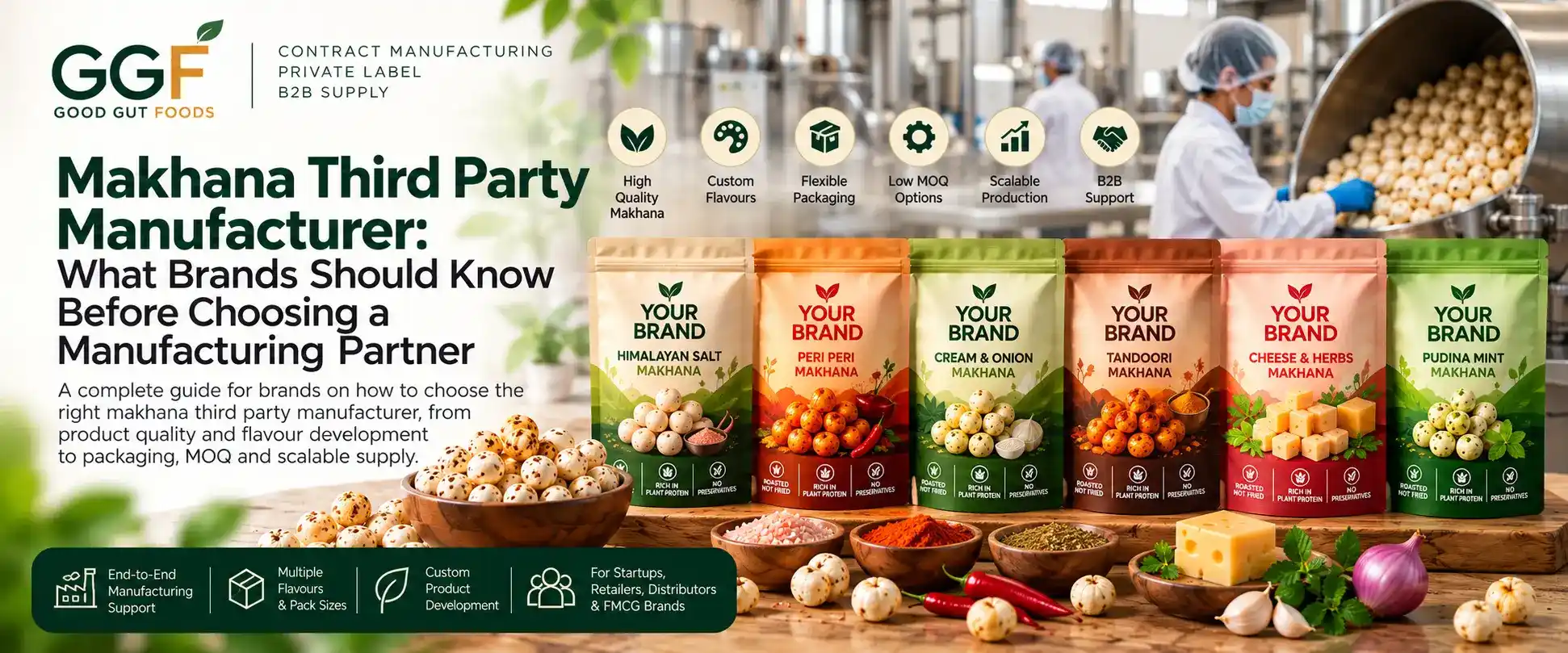
Launching a snack brand does not always require owning a manufacturing facility. For many FMCG startups, retailers, distributors and established brands, working with a makhana third party manufacturer can be a more practical way to develop, produce and scale their own snack products.
Third-party manufacturing allows a brand to focus on branding, sales, distribution and marketing while the manufacturing partner handles production.
For makhana brands, however, choosing the right manufacturer is important because product quality, roasting, flavour consistency, packaging and supply reliability can directly affect the final product.
What Is Makhana Third Party Manufacturing?
Makhana third party manufacturing is a model where a brand outsources the production of its makhana products to an experienced food manufacturer.
Depending on the arrangement, the manufacturer can support different stages of the process, including:
Makhana sourcing and processing
Roasting
Flavouring and seasoning
Product development
Packaging
Batch production
Quality checks
Bulk supply
Private label packaging
The finished product is then sold under the brand's own name.
This model is particularly useful for businesses that want to enter the healthy snacking category without investing heavily in their own production infrastructure.
Why Brands Choose a Third Party Makhana Manufacturer
Building an in-house food manufacturing facility requires investment in machinery, manpower, quality systems, storage, production management and regulatory processes.
Third-party manufacturing can reduce the operational burden.
A brand can potentially:
Launch products faster
Avoid major manufacturing investment
Test different flavours
Start with selected SKUs
Scale production as demand grows
Focus more on branding and distribution
Develop its own private label snack range
For startups and emerging FMCG brands, this can make the initial market-entry process considerably more manageable.
What Should You Look for in a Makhana Third Party Manufacturer?
Not every snack manufacturer is necessarily the right fit for makhana.
Before finalising a manufacturing partner, evaluate the following factors.
1. Makhana Product Quality
The quality of the final product starts with the makhana itself.
Ask the manufacturer about:
Raw makhana sourcing
Size and grading
Roasting process
Texture
Crunch
Product appearance
Batch consistency
A manufacturer should be able to consistently produce the product specification that your brand has approved.
2. Flavour Development Capability
Flavoured makhana is not simply about adding seasoning.
The manufacturer needs to understand how different seasonings interact with roasted makhana while maintaining the desired taste and texture.
Depending on your brand positioning, you may want flavours such as:
Himalayan Salt
Peri Peri
Cream & Onion
Mint
Tandoori
Cheese & Herbs
Custom proprietary flavours
A strong manufacturing partner should also be able to work with your flavour requirements instead of forcing your brand into a fixed product range.
3. Private Label Packaging Support
If you are launching your own makhana brand, manufacturing is only one part of the requirement.
You may also need support with:
Pouch packaging
Jar packaging
Composite cans
Pack-size selection
Packaging specifications
Product filling
Labelling requirements
Batch coding
A third-party manufacturer capable of supporting both manufacturing and private-label requirements can simplify the entire process.
4. MOQ and SKU Flexibility
MOQ can significantly affect the economics of a new snack brand.
Ask the manufacturer:
What is the minimum order quantity per SKU?
Does MOQ apply separately to each flavour?
Can multiple flavours be launched together?
Is there flexibility for startups?
How does MOQ change at higher volumes?
This becomes particularly important when launching a range of flavoured makhana rather than a single SKU.
5. Production Capacity and Scalability
Your manufacturing partner should be able to support your brand beyond the first order.
A useful question is:
“If our monthly requirement increases significantly, can you support the additional volume?”
A supplier who can handle your first 100–200 kg but cannot support future growth may eventually become a bottleneck.
Look for a manufacturer with an organised production setup and the ability to scale according to demand.
6. Batch-to-Batch Consistency
One of the biggest challenges in outsourced food manufacturing is consistency.
Customers expect the same:
Taste
Crunch
Flavour intensity
Appearance
Pack weight
Overall eating experience
in every purchase.
Before placing a large order, brands should approve product samples and clearly communicate the product specifications expected for commercial production.
7. Lead Time and Supply Planning
Lead time matters when you are selling through retailers, marketplaces or distributors.
Ask about:
Production lead time
Packaging lead time
Raw material availability
Repeat-order timelines
Dispatch process
Bulk-order planning
Reliable planning becomes even more important when your product is already selling at scale.
Third Party Manufacturing vs Private Label Manufacturing
These terms are often used interchangeably, but there can be a difference in how brands use them.
Third-party manufacturing generally refers to outsourcing the production of a product to another manufacturer.
Private label manufacturing focuses more specifically on producing products that are sold under the buyer's own brand.
For example, a brand may approach a manufacturer for:
“Produce flavoured makhana according to our specifications and pack it under our brand.”
That requirement can involve both third-party manufacturing and private-label services.
The exact scope should therefore be discussed before placing the order.
Who Can Benefit From Third Party Makhana Manufacturing?
This model can work for several types of businesses.
FMCG Startups
Startups can test their product-market fit without building their own manufacturing facility.
Retail Brands
Retailers can introduce their own branded healthy snack range.
Distributors
Distributors can develop exclusive snack products for their network.
D2C Brands
Online-first brands can outsource production while focusing on customer acquisition and brand building.
Corporate Gifting Companies
Businesses offering healthy food gifting can source branded makhana products in bulk.
Exporters
Export-focused businesses can work with an Indian manufacturer to develop and supply makhana products for international markets.
Questions to Ask Before Finalising a Makhana Manufacturer
Before signing off on a manufacturing partner, ask:
What makhana products do you manufacture?
Can you develop custom flavours?
What is the MOQ per flavour?
What packaging formats are available?
Can you manufacture under our brand?
What is the typical production lead time?
Can you support repeat and larger-volume orders?
How is product consistency maintained?
Can we approve samples before production?
What information is required to prepare a quotation?
Getting these answers early can prevent misunderstandings later.
The Right Manufacturing Partner Is More Than a Supplier
For a growing snack brand, a manufacturing partner should not be viewed only as a place to purchase finished products.
The right partner can become part of the product development and supply chain.
From flavoured makhana development and sampling to packaging and commercial production, the objective should be to build a repeatable system that can support the brand as it grows.
For businesses entering the makhana category, this can be much more valuable than simply finding the lowest manufacturing price.
Looking for a Makhana Third Party Manufacturer?
Good Gut Foods works with businesses looking for private label, third-party and B2B snack manufacturing solutions, with a strong focus on flavoured makhana and healthy snacks.
If you are planning to launch your own makhana brand, develop a new flavoured makhana SKU or source makhana products for retail and distribution, you can explore Flavoured Makhana and discuss your product requirements with the Good Gut Foods team.