How to Choose the Right Private Label Makhana Manufacturer for Your Brand
Launching a makhana brand can look straightforward: choose a product, create your packaging, add your brand name and start selling.
But for a business entering the snack market, choosing the right manufacturing partner is an important part of the process.
A private label makhana manufacturer can support everything from product selection and flavour development to packaging and commercial production. For a growing brand, the right manufacturing setup can also make it easier to move from initial orders to larger B2B volumes.
If you are searching for a private label makhana manufacturer, here are the key factors to consider before selecting a partner.
What Is Private Label Makhana Manufacturing?
Private label manufacturing allows a business to sell a food product under its own brand, while an external manufacturer handles production.
For makhana, a private label project may involve:
Roasted makhana
Flavoured makhana
Custom seasoning profiles
Custom pack sizes
Branded packaging
Product development
Bulk B2B supply
Contract manufacturing
This model allows startups, retailers, distributors, exporters and established FMCG businesses to develop their own snack products without establishing a dedicated manufacturing facility.
Good Gut Foods provides private label and co-packing solutions covering product selection, flavour customisation, packaging and manufacturing.
1. Check the Manufacturer's Makhana Product Capability
The first question is simple:
Does the manufacturer actually specialise in the product you want to sell?
If your requirement is roasted or flavoured makhana, look for a partner with experience in producing these formats at commercial scale.
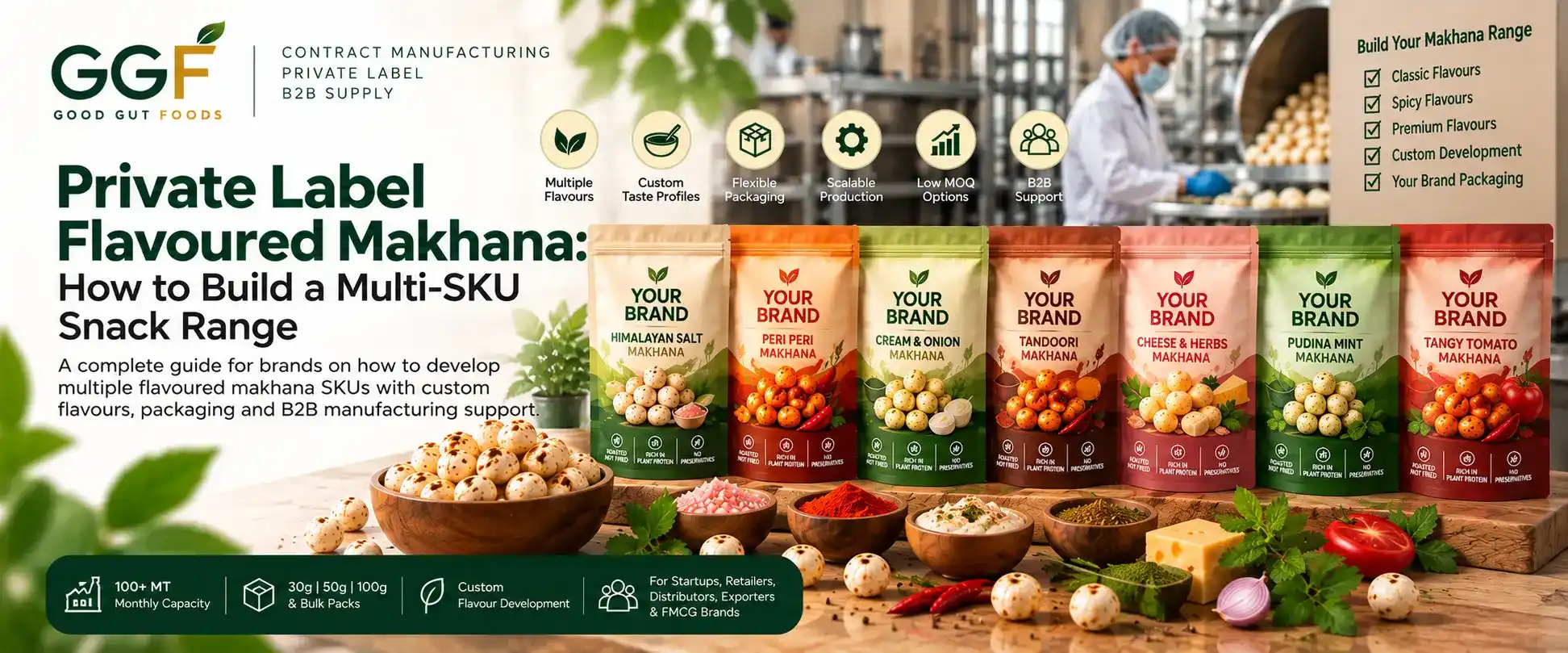
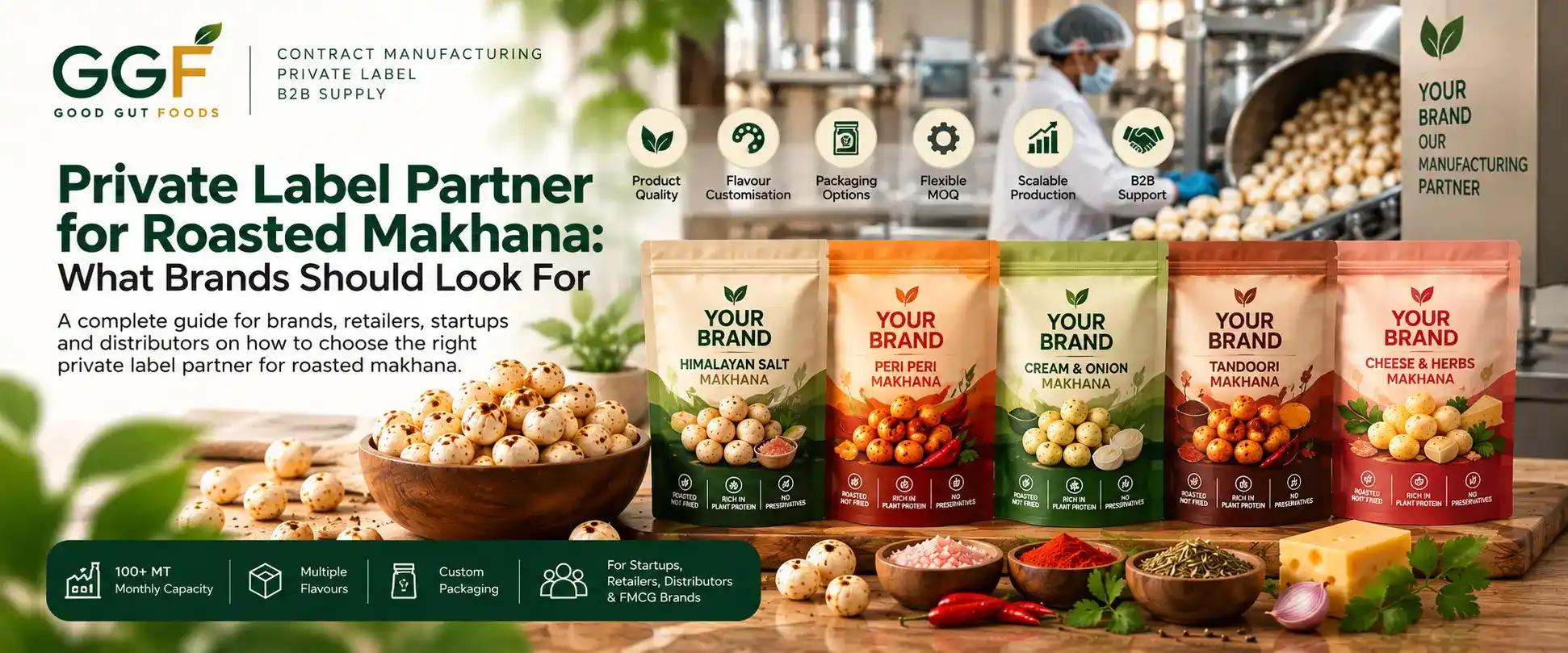
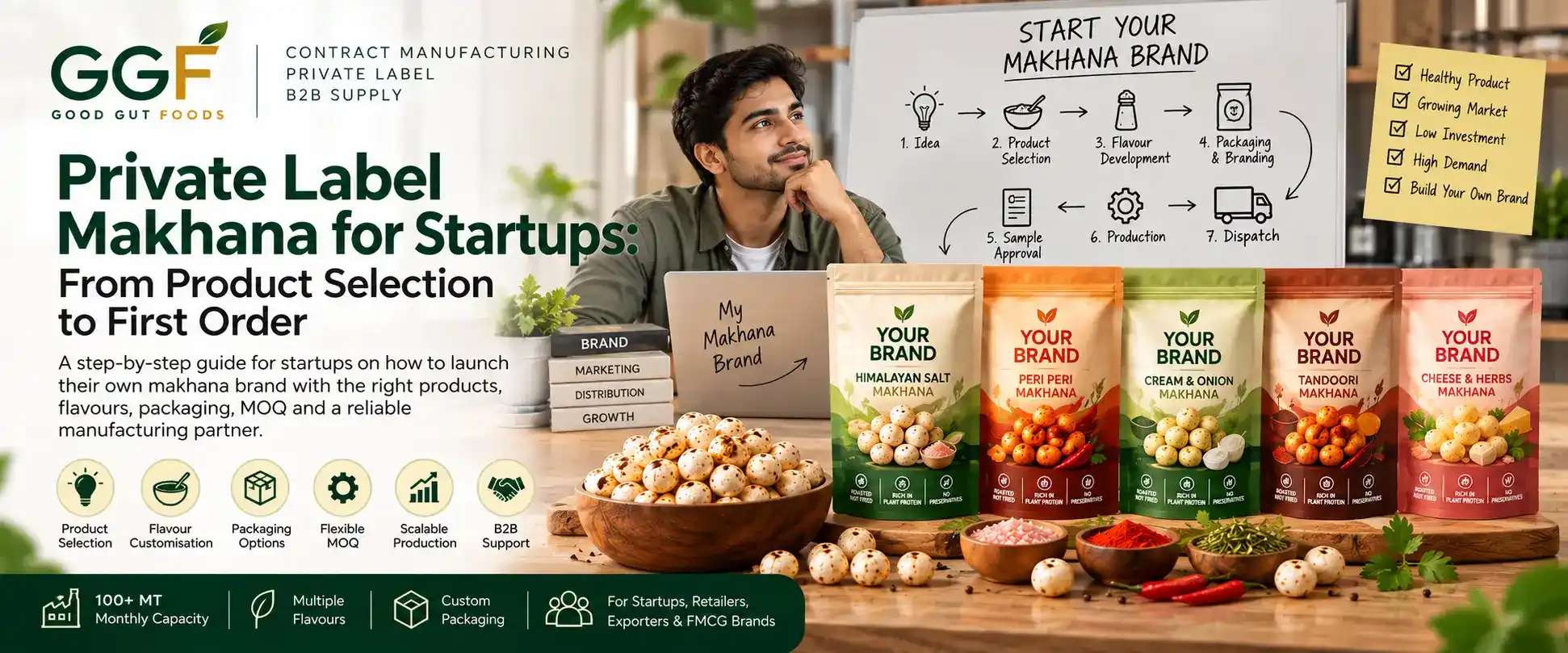
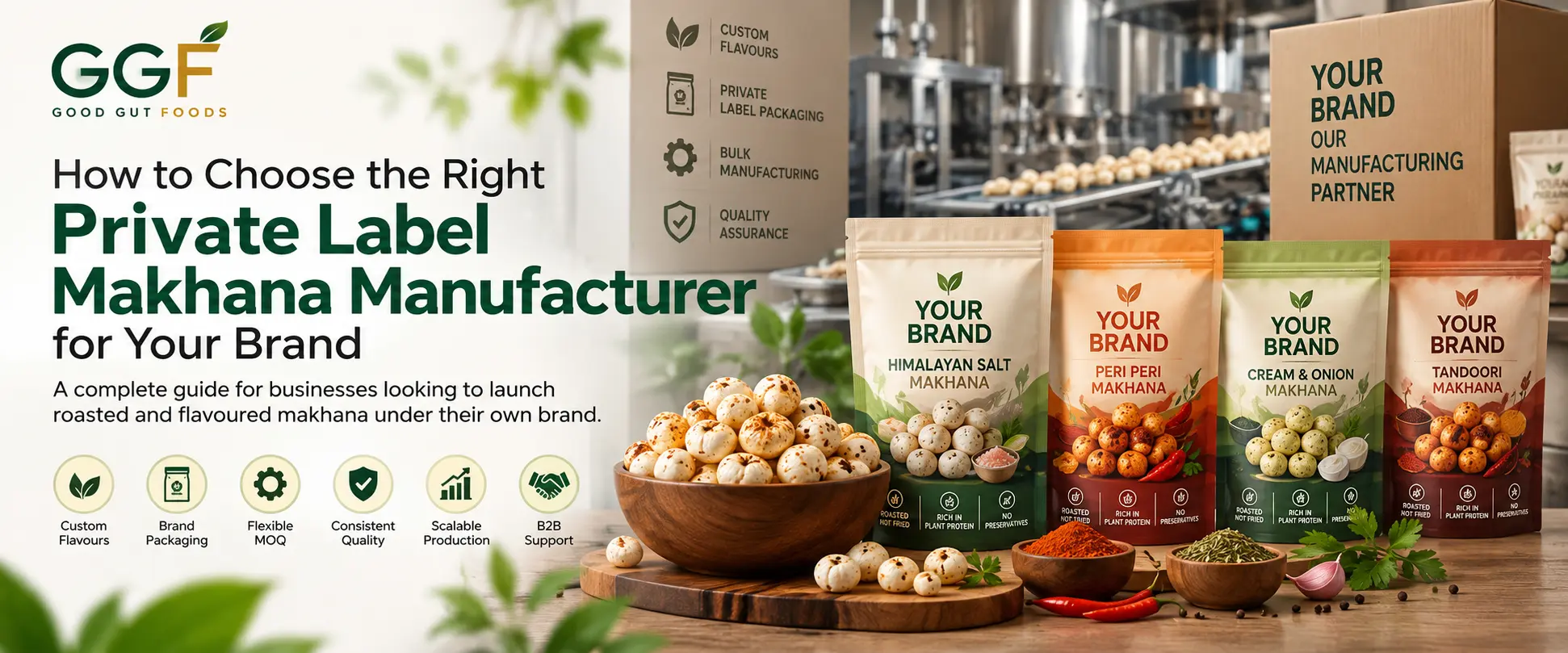
Good Gut Foods offers flavoured makhana in multiple flavour profiles, including Peri Peri, Cheese & Herbs, Cream & Onion, Himalayan Pink Salt, Tandoori, Tangy Tomato and Pudina Mint. The company also offers bespoke flavour profiling for private label requirements.
This can be important when your goal is to build a product range rather than sell a single standard SKU.
2. Ask About Flavour Customisation
A private label brand needs a product that fits its own positioning.
You may want:
A specific flavour
A particular seasoning intensity
A combination of flavours
A premium flavour profile
A product designed for a particular market
Therefore, ask your manufacturer whether it offers custom flavour development or seasoning adjustment.
Good Gut Foods states that its makhana seasoning levels and flavour profiles can be customised according to the brand's specifications.
This gives a brand more control over the final product instead of simply putting its label on an unchanged product.
3. Check Private Label Packaging Options
Manufacturing is only one part of launching a branded snack.
Your product also needs packaging that works for your sales channel.
Depending on your business model, you may need:
Retail pouches
Jars
Different pack sizes
Custom branding
Export-oriented packaging
Bulk packaging
Good Gut Foods offers customised retail packaging formats, sizes and private label branding options for domestic and global requirements.
Its private-label policy also states that standard pouch dielines are available for 30g, 50g, 100g and bulk pillow pouches.
When speaking to a manufacturer, ask whether it can manage both product manufacturing and branded packaging.
4. Understand the MOQ Before Placing an Order
MOQ, or Minimum Order Quantity, can have a major impact on your launch economics.
Before selecting a private label supplier, clarify:
MOQ per SKU
MOQ per flavour
MOQ for different pack sizes
Sample requirements
Repeat-order quantity
Bulk-order pricing
Good Gut Foods states that it offers flexible startup MOQ structures, with product specifications and packaging requirements confirmed before mass production.
For a startup or new brand, understanding MOQ early can help you plan inventory and working capital.
5. Evaluate Production Capacity
Your first order may be relatively small.
But what happens if your brand expands?
A manufacturer should ideally be able to support increasing requirements as your B2B business grows.
Ask:
What is the production capacity?
Can the manufacturer handle repeat orders?
Can multiple flavours be produced?
Can production volumes be increased?
What is the typical lead time?
Can the manufacturer support export orders?
Good Gut Foods states that its manufacturing operations have 100+ metric tons of monthly production capacity, along with flexible MOQ structures and export-ready logistics.
6. Don't Ignore Quality and Production Consistency
When you sell a product under your own brand, the customer sees your brand, not your manufacturing partner.
That means consistency matters.
Before selecting a manufacturer, ask about:
Raw material sourcing
Roasting process
Seasoning consistency
Batch quality
Food-safety systems
Product specifications
Shelf-life testing
Packaging controls
Good Gut Foods states that its makhana is manufactured in a certified facility in Jaipur and that its B2B processes include quality and food-safety controls. Its manufacturing terms also describe batch testing and product-specification approval before mass production.
7. Ask About Samples and Product Approval
Before committing to a large production run, it is useful to evaluate the actual product.
For private label manufacturing, this can include reviewing:
Product texture
Roast profile
Flavour
Seasoning level
Packaging
Product specifications
Good Gut Foods' private-label policy describes a pre-production pilot sample and client approval process before full production.
This type of approval process helps establish what the final commercial product should look and taste like before mass production begins.
8. Look Beyond the Manufacturing Price
When comparing private label manufacturers, don't compare only the quoted price per kilogram.
Your overall B2B cost can depend on:
Product + customisation + packaging + production + logistics + order quantity
A manufacturer with a slightly different product price may provide different packaging, customisation or supply arrangements.
Ask for a complete quotation based on your actual requirement:
Product + flavour + pack size + packaging + quantity + delivery requirements
This makes supplier comparisons more meaningful.
Why Businesses Choose Private Label Makhana
Makhana gives businesses the opportunity to build a dedicated snack category under their own brand.
A brand can develop:
Roasted makhana
Flavoured makhana
Multiple flavour SKUs
Different pack sizes
Premium snack variants
Retail snack products
Corporate gifting products
Export-oriented products
Instead of building its own manufacturing facility, the business can focus on branding, distribution, marketing and customer acquisition, while the manufacturing partner handles production.
Who Can Use a Private Label Makhana Manufacturer?
Startups
Food startups can develop their own makhana brand without setting up a complete manufacturing facility.
Existing FMCG Brands
An existing snack or food brand can add makhana as another product category.
Retailers
Retailers can develop their own branded snack range.
Distributors
Distributors can source products under their own brand or develop exclusive SKUs for their market.
Exporters
Export businesses can source Indian-made makhana for their international markets, subject to applicable destination-market requirements.
Corporate Gifting Businesses
Makhana can also be included in branded healthy snack hampers and corporate gifting programs.
Questions to Ask a Private Label Makhana Manufacturer
Before finalising a manufacturing partner, ask:
Do you manufacture roasted and flavoured makhana?
Can you customise flavours?
Can you manufacture under my brand?
What packaging formats are available?
What is the MOQ?
Can I order multiple flavours?
What is the production lead time?
Can you support repeat and bulk orders?
Can I approve samples before production?
What quality and food-safety processes are followed?
Can you support export requirements?
Can you provide a complete B2B quotation?
These questions can help you evaluate whether a supplier is suitable for your specific business requirements.
Private Label Makhana With Good Gut Foods
Good Gut Foods provides private label, OEM/ODM and contract manufacturing solutions for food businesses looking to develop branded snack products.
For flavoured makhana, the company offers customisable flavour profiles, private label packaging and B2B supply capabilities.
The wider Good Gut Foods portfolio also includes products such as Ragi Chips, Corn Chips, Flavoured Chana, Trail Mix, Seed Mix, Date Bites, Protein Bites, Okra Chips and Beetroot Chips, allowing businesses to explore multiple snack categories with a manufacturing partner.
Looking for a Private Label Makhana Partner?
If you are planning to launch roasted or flavoured makhana under your own brand, Good Gut Foods can discuss your requirements around product, flavour, packaging and B2B manufacturing.
Request a B2B Quote for Private Label Makhana
Share your required flavour, pack size, quantity and branding requirements with the Good Gut Foods B2B team.
Request a B2B Quote for Flavoured Makhana
Frequently Asked Questions
What is a private label makhana manufacturer?
A private label makhana manufacturer produces roasted or flavoured makhana for a business that sells the finished product under its own brand.
Can I customise the flavour of private label makhana?
Yes. Good Gut Foods offers bespoke flavour profiling and customisable seasoning levels for its flavoured makhana.
Can startups launch their own makhana brand?
Yes. Private label manufacturing allows startups to outsource production instead of establishing their own manufacturing facility. MOQ, packaging and product requirements should be discussed with the manufacturer.
Can I order multiple makhana flavours?
Multiple flavour SKUs can be developed depending on the manufacturer's capabilities and the agreed product specifications.
Can private label makhana be exported?
Private label makhana can be developed for export markets. However, the buyer and manufacturer should confirm the destination country's applicable food, labelling, packaging and documentation requirements before production.
What should I look for in a makhana contract manufacturer?
Consider product capability, flavour customisation, packaging, MOQ, quality systems, production capacity, lead time and B2B support rather than evaluating the supplier only on price.